Akhtala Fortress Monastery
Akhtala Fortress Monastery
Perched above the Debed Gorge, Akhtala Fortress Monastery preserves among the most remarkable 13th-century Georgian-Byzantine frescoes of the Caucasus, within a setting of still-standing medieval fortifications.
Perched on a rocky spur dominating the Debed Gorge, Akhtala Fortress Monastery ranks among Armenia's best-preserved medieval complexes. Founded in the 10th century, it houses Byzantine frescoes of rare quality for the region. Its massive ramparts, still standing, testify to a site that was as much a stronghold as a Georgian-Orthodox spiritual center. The combination of military architecture, sacred art, and gorge landscape makes it an essential stop along the Lori route.
Quick Facts
- Access: from Alaverdi (about 25 km) or Vanadzor, by car or taxi; the road follows the Debed Gorge.
- Recommended duration: 1 to 1.5 hours for the complete site.
- Dress code: shoulders and knees covered to enter the main church.
- Accessibility: sloped terrain and uneven paving; wheelchair access difficult.
What to See
The site comprises a fortified enclosure with medieval towers and gates, and a main church dedicated to the Virgin (12th–13th century). The interior preserves a cycle of Georgian-Byzantine frescoes covering almost the entire walls and vault: evangelical scenes, portraits of saints, deesis. The quality of pigments and fineness of the faces distinguish these paintings from most contemporary Armenian decorative schemes.
History and Context
Akhtala was initially an Armenian castle of the Kyurikids, then came under Georgian control in the 12th century. Queen Tamar and her successors transformed it into a Georgian-Orthodox monastery, which explains the fresco style, distinct from the Armenian Apostolic tradition. The site also served as a princely residence and defensive point on the trade route linking Georgia to Persia. After centuries of partial abandonment, consolidation work has stabilized the ramparts and protected the frescoes.
Highlights of the Visit
The Main Church Frescoes
This is the heart of the site. The iconographic program covers the nave, apse, and narthex. Certain scenes—notably the Dormition of the Virgin and the Last Judgment—retain vivid colors despite the centuries. Take time to let your eyes adjust to the dim light before seeking out details.
The Ramparts and Towers
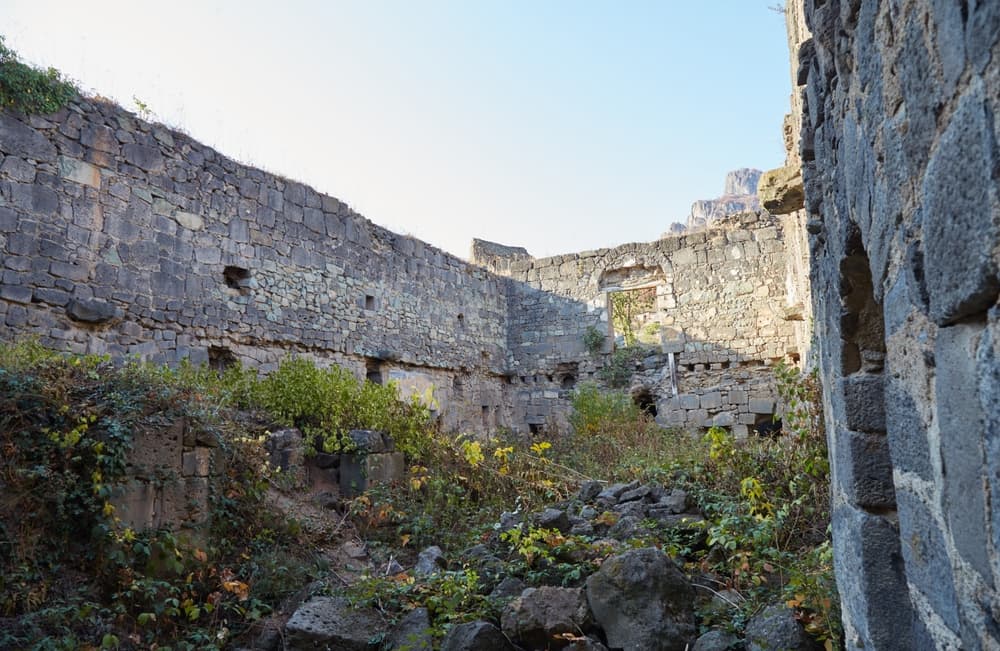
The partial patrol walk allows you to follow the walls and observe the coursed rubble construction. From the northern and eastern angles, the view plunges over the forested Debed Gorge—a striking contrast with the gray stone fortifications.
The Main Gate and Fortified Entrance
Access to the monastery is through a gate framed by square towers. The ensemble gives a precise idea of medieval Caucasian military architecture, different from contemporary fortresses of Western Europe.
Etiquette and Visit Rules
- Cover shoulders and knees before entering the church.
- Speak softly inside; the site remains an active place of worship for the local community.
- Do not touch the frescoes: skin oils accelerate their degradation.
- Ask before photographing if a service is underway.
Photography Tips
Morning light illuminates the church's western facade and northern ramparts. For the frescoes, a soft torch or compact reflector helps without flash (flash is discouraged). Outside, the best angle on the entire monastery is taken from the access path below, gorge-side, in late afternoon when raking light models the stones.
Location and Access
Akhtala is located in Lori province, northern Armenia, about 25 km northwest of Alaverdi. The road from Alaverdi follows the Debed Gorge and passes near several other medieval monasteries. By car, the journey from Vanadzor takes about 45 minutes. There is no regular public transport to the site; a taxi from Alaverdi or a rental car remain the most practical options. Parking is available at the site entrance.
Nearby Attractions
- Haghpat Monastery — UNESCO site about twenty kilometers away, with a 10th-century cathedral church and a remarkable gavit.
- Sanahin Monastery — another UNESCO site in the Debed Gorge, known for its khachkars and medieval scriptorium.
- Alaverdi — industrial gorge town, logistics base for exploring Lori's monasteries.
Frequently asked questions
Spring (April–June) and autumn (September–October) offer pleasant temperatures and colorful vegetation in the gorge. Summer is warm but manageable. In winter, the road may be snowed and access difficult.
Yes, all three sites are in the same Debed Gorge area. A full day from Alaverdi or Vanadzor allows visiting all three without rushing, provided you start early in the morning.
They are among the best preserved in medieval Caucasia, but some areas have suffered from humidity and time. Consolidation work has been conducted; the essential iconographic program remains legible.
Photography without flash is generally tolerated. Avoid flash to prevent damage to pigments. If a religious service is underway, wait for its end before using your camera.
There is not necessarily an official guide on site. For an in-depth visit to the frescoes and Georgian history of the monastery, it is advisable to book a local English-speaking guide from Alaverdi or Vanadzor through an agency.
Interested in this visit?
We can include it in your personalised itinerary.