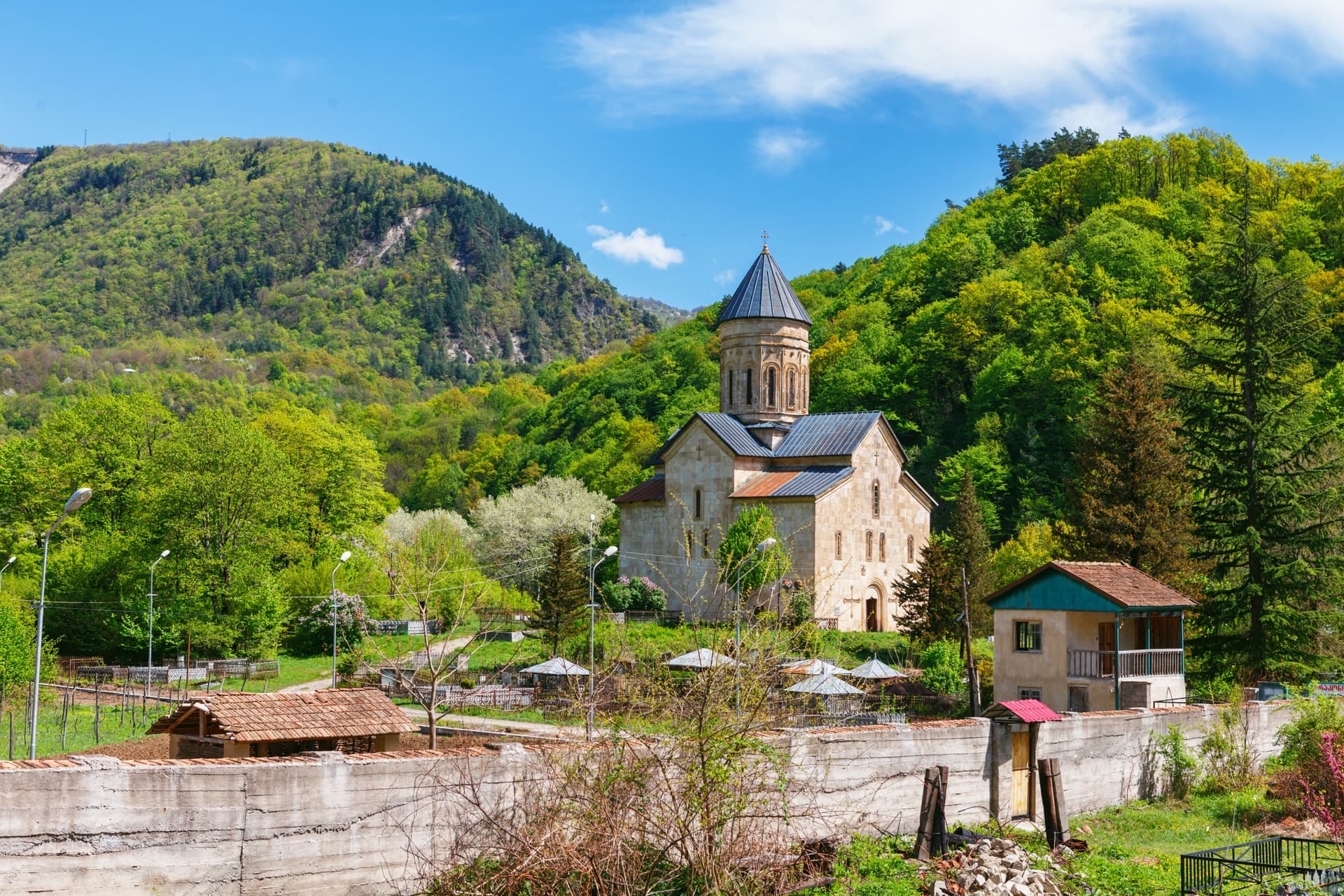
Racha Region
The Racha region is located in the western part of Géorgie. It is particularly renowned for its caves, mountains and exceptional viewpoints.
The Racha region is located in the western part of Géorgie. It is particularly renowned for its caves, mountains and exceptional viewpoints.
Beyond its generous natural landscape, Racha is also of considerable interest for its numerous historical monuments, its authentic Georgian gastronomy and above all its wine, Khvanchkara.
This region, one of the most beautiful in Géorgie, is an unmissable addition to your itinerary.
History of Racha Region
Thanks to archaeological discoveries, human occupation of Racha is attested to the Neolithic period. In antiquity, it was part of the Kingdom of Iberia and Colchis.
Its capital, Oni, is said to have been founded by King Parnadjom I in the 2nd century BC.
The majority of archaeological remains from Racha date from the Bronze Age, particularly the "Tsageri Treasure". This treasure dates from the 9th–10th centuries BC.
At this time, the region, which abounded in copper mines, allowed local artisans to
manufacture weapons, bronze figurines and pottery in large quantities and then export them as far as Egypt and Phoenicia.
During the unification of the Georgian kingdom in the 11th century, Racha became one of the duchies. Rati is the first duke appointed by King Bagrat III. He was from the Baghvashi family.
The descendants of Rati and his son Kakhaber governed the province of Racha until 1278. Then, King David VI Narin revoked the duchy during the war he waged against the Mongols in 1278.
In the mid-14th century, under the governance of the Charelidze family, the duchy of Racha was finally restored.
Under Rostom (1749–1769), the duchy virtually separated from Imereti.
At the end of 1769, King Solomon I of Imereti arrested Rostom and then abolished the duchy once again.
Under the occupation of the Russian Empire, the districts of Racha and Lechkhumi were attached to the governorate of Kutaisi.
Racha Region Today
Racha (written this way in Georgian), pronounced Ratcha, is a historic region of Géorgie now part of the Racha-Lechkhumi and Lower Svaneti region.
It lies on the edges of the Greater Caucasus, in the upper valley of the Rioni River and its tributaries.
Rich in mineral waters and abundant high-altitude thermal springs, Racha was, during the Soviet era, a region highly prized by tourists.
Today, it still maintains considerable tourism potential.
Its forests, waters and cliff faces, such as the Shovi amphitheatre, are assets that make Racha a premier destination. But what particularly gives the region its reputation is its quality wine produced in the Ambrolauri district: Khvanchkara.
Racha, Discovering the Pearl of the Caucasus
Racha, a region that once belonged to the kingdoms of Iberia and Colchis, is located in the northwestern part of Géorgie, 300 km from Tbilisi. This mountainous region, separated from Russia to the north by the Caucasus peaks, is particularly colorful in autumn, from September to October.
Racha, one of the most beautiful regions of Géorgie, is divided into 3 parts:
Upper Racha, Lower Racha and Mountain Racha.
Lower Racha, also called Nether-Racha, is renowned for its hospitable people, its abundant forested nature and excellent wine.
Upper Racha captivates visitors with its high-altitude villages and views of peaks ranging between 3,300 and 3,600 meters in elevation.
The mountainous part of Racha lies between the main Caucasus range and Mount Shoda-Kedela. This part of the region is ideal for trekking or hiking.
It is home to 2 gorges and several villages to explore, such as Ghebi, Nostara and Gona, all located in the Oni district.
Lower Racha also offers other interesting routes, including the discovery of the village of Skhvava. The site comprises a cave known as the "refrigerator," ruins of a fortress, the historic church of Krikhi and the Krikhula River.
To cool off between hiking circuits, the Tkhmori waterfall is an pleasant spot for bathing.
Exploration of Racha continues with a trek up Mount Tskhrajvari.
To discover this unique place in the world, you must travel approximately 3 kilometers of rocky road, then climb to 1,565 meters above sea level. Once you reach the mountain's summit, you will be rewarded with an exceptional view of the surrounding landscape.
The next natural site not to miss in Racha is Lake Shaori, the largest lake in the region.
It is the best place for a picnic, especially during the summer season. If you plan to discover Lake Shaori in autumn, you will see the colorful trees surrounding it reflected in the water. This lake is also very interesting for fishermen, particularly for 10 kg carp that can be caught there.
Near the lake, after a 10-minute walk, you reach the village of Nikortsminda.
It is home to a vast temple dating from the 10th century as well as the Nikortsminda Monastery, erected between 1010 and 1014, a symbol of the golden age of Georgian architecture.
Its architecture combines archaic and modern elements.
The ornaments of its façades are unique and its buildings date from the 11th century, but you can also see paintings from the 15th century highlighting the lords of Racha and Imereti of that era.
The restoration of this monastery, with its uniquely designed interior architecture, was completed in 2012.
From Nikortsminda, you can reach the ruins of Udabno (Chelishi) and the source of the Shareula River.
Take the opportunity to also visit the Sakinule cave.
Its interior temperature is extremely low compared to outside, so it is preferable to explore this cave in summer.
Discovering Racha can also be marked by a gastronomic stopover.
Local dishes such as Lobiani and smoked pork are flavors to discover.
Accompany these traditional dishes with the famous Georgian wine called Khvanchkara.
This excellent semi-sweet wine comes specifically from this region and is made from two grape varieties: Alexandria and Mudzhuretuli.
It is dark red (ruby) in color and has a raspberry flavor.
Key Towns of Racha
The small town of Ambrolauri, with 2,000 inhabitants, can be your first stop in the Racha region. Standing at 550 meters above sea level, it is the administrative center of the region.
You will find beautiful historical and cultural points of interest, such as the Museum of Fine Arts.
It preserves more than 500 masterpieces created by renowned Georgian painters, namely Varazi, Gudiashvili, Kakabadze…
The museum is open daily, except Monday, between 10 a.m. and 5 p.m.
Moreover, if you are a history enthusiast, visit the town of Oni, which is located 30 km from Ambrolauri. According to legend, this town was founded in the 2nd century BC.
Considered the historic heart of Racha, it houses a museum, ruins of medieval forts, a synagogue built in 1895 and Orthodox churches.
Furthermore, more than 15,000 archaeological artifacts, ethnographic objects and various architectural components are displayed in the Oni Museum, founded in 1937.
Coins, textiles, illuminated manuscripts… are some of these ethnographic items. It is open from 10 a.m. to 5 p.m.
During your visit to the town, also explore the "House of Artists" museum to immerse yourself in local culture. This museum houses pottery and ancient Georgian weapons, artifacts, but also shells and insects dating back 50 million years.
If you have some time left, also visit the villages of Shovi and Utsera, located near Oni.
Climate in Racha Region
In this region, the climate is generally humid, with long, cold winters and fairly short, warm summers.
For example, in Ambrolauri, the climate is warm and temperate. Heavy rain falls throughout the year, even during the driest months. The average annual humidity rate is 76%, with average precipitation of 1,042 mm each year. As for average temperature, it reaches 10.4°C.
In Oni, the climate is temperate. Precipitation remains substantial year-round.
The town has an average temperature of 11°C throughout the year. Average precipitation is 959 mm each year.
By Bus:
To reach Oni or Ambrolauri, take a marshrutka from Didube Station in Tbilisi or from Kutaisi.
From Kutaisi, marshrutkas can take two routes:
- Either they take the shorter route via Ambrolauri–Tkibuli. The journey time is approximately 3 hours to reach Racha.
Departure is at 4 p.m. from Okriba Station, located on Chavchavadze Street in Kutaisi. Arrival in Oni is at 6:30–7 p.m. and arrival in Ambrolauri is at 6–6:30 p.m.
- By choosing the longer route, the marshrutkas pass through villages in Lechkhumi, Tvishi and Alpana, as well as through the Rioni Gorge.
They depart at 9 a.m. from Javchis Khidi Station – Chain Bridge in Kutaisi and arrive in Oni at 1:30–2 p.m.
By Taxi:
Taxis can also connect Tbilisi to the Racha region, particularly from Didube Station in Tbilisi, for
approximately 30 GEL per person.