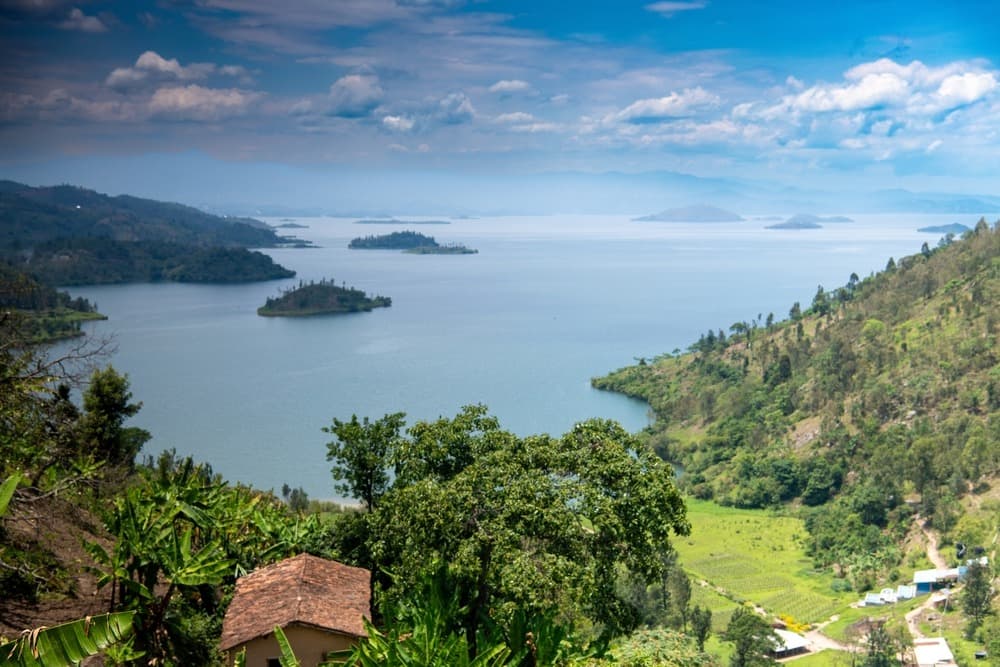
Lake Kivu
Lake Kivu
A natural border between Rwanda and the DRC, Lake Kivu blends temperate waters, inhabited islands, hiking trails and singular geology at the foot of volcanoes.
Lake Kivu stretches for nearly 90 km along the border between Rwanda and the Democratic Republic of the Congo, within the Albertine Rift Valley. With an area of roughly 2,700 km² and a maximum depth of 485 metres, it ranks among Africa's deepest lakes. Its singular nature lies in its meromictic character: its waters do not mix uniformly, and its deep layers contain considerable volumes of dissolved methane and carbon dioxide. On the Rwandan side, its shores border the cities of Gisenyi, Kibuye and Cyangugu, and form one of the country's leading leisure regions.
Why visit Lake Kivu
- An altitude lake with temperate waters (23–27°C) ideal for swimming, free from bilharzia and hippopotamuses.
- 230 km of marked trails around the lake, open for hiking and cycling (Congo Nile Trail).
- Inhabited islands to explore by boat, including Idjwi and Nyamunini.
- Distinctive geology at the foot of Nyiragongo and Nyamuragira volcanoes.
- A logical stop between Volcanoes National Park, Nyungwe Forest and Kigali.
What to see and do
The shores and lakeside towns
On the Rwandan shore, three entry points structure the visit: Gisenyi (Rubavu) to the north, facing Goma; Kibuye (Karongi) in the centre, the calmest and most sheltered; Cyangugu (Rusizi) to the south, close to Nyungwe Forest. Fresh fish markets punctuate local life, supplied by artisanal fishing of tilapia and isambaza (sambaza), a small fish caught at night by lamplight.
The islands of the lake
Several boat excursions depart from Kibuye and Gisenyi:
- Idjwi Island: the largest, on the Congolese side, known for its traditional agriculture and well-preserved local culture.
- Nyamunini Island: nicknamed "Napoleon Island" because of its silhouette evoking a bicorn hat.
- Tembabagoyi Island: a refuge for the African striped straw-coloured bat, an endemic species observable at dusk.
Hiking and cycling
The network of 230 km of marked trails crosses coffee, tea and cassava plantations, riverside villages and wooded hills. The Gisenyi–Kibuye stretch is the most popular for cycling and can be completed over several days.
Water activities
Kayaking, canoeing, windsurfing and dugout canoe excursions are offered by lakeside hotels. Water temperatures ranging from 23 to 27°C allow for swimming year-round.
Fauna and flora
The lake basin is home to approximately 5 species of amphibians, 6 of reptiles, 6 of mammals, 52 of invertebrates and 142 recorded plant species. Fish populations number 28 species (tilapia, isambaza) and 4 freshwater crab species. Among birds, you will commonly observe the red-capped robin-chat, black kite and cattle egret.
Geology and chemical particularity
Lake Kivu occupies a tectonic trough of the western branch of the East African Rift. The underlying volcanic activity, linked to the proximity of Nyiragongo and Nyamuragira, feeds the deep layers with dissolved gases: approximately 60 km³ of methane (CH₄) and 300 km³ of carbon dioxide (CO₂) are measured there.
This accumulation poses a theoretical risk of limnic eruption, that is the abrupt release of gases to the surface. The phenomenon has been documented on a smaller scale at Lakes Nyos and Monoun in Cameroon in the 1980s. Lake Kivu is subject to continuous scientific monitoring under the Lake Kivu Monitoring Programme (LKMP), conducted with Eawag, the Swiss Federal Institute of Aquatic Science and Technology.
In parallel, the KivuWatt project extracts methane from the deep layers to generate electricity fed into the Rwandan grid. The operation has a dual objective: to supply local energy and to progressively reduce gas concentration in the lake. Further methane units are under study on the shores.
When to visit
The lake is accessible year-round, but visit comfort varies by season:
- June to mid-September: long dry season, ideal for hiking, cycling and boat outings.
- Mid-December to February: short dry season, sunny and warm.
- March–May and October–November: rainy seasons, showers often in late afternoon; vegetation is at its peak but some trails become muddy.
Temperatures on the shores oscillate between 18 and 28°C depending on altitude (the lake sits at roughly 1,460 m).
Practical information
- Duration of stay: 1 to 3 days for a beach stopover; allow 4 to 7 days to cover the Congo Nile Trail by bike.
- Accommodation: wide range in Gisenyi, Kibuye and Cyangugu, from simple guesthouses to lakeside lodges.
- Safety: the Rwandan shore is calm. Crossings to the DRC require a visa and heightened caution depending on the situation in Goma and Bukavu.
- Health: waters are reputed free of bilharzia, but favour designated swimming zones indicated by hotels.
- Money: ATMs available in Gisenyi, Kibuye and Cyangugu; bring cash for villages.
How to get there
From Kigali, three paved road routes serve the main lakeside cities:
- Kigali–Gisenyi (Rubavu): roughly 160 km, 3 to 4 hours by road via Musanze. This is the quickest and most frequented access.
- Kigali–Kibuye (Karongi): roughly 135 km, 3 hours, via Muhanga. The road descends in hairpin bends to the lake.
- Kigali–Cyangugu (Rusizi): roughly 220 km, 5 to 6 hours, via Nyungwe. Convenient for combining with the forest.
Shared minibuses and private coach operators connect Kigali daily to all three cities. Private transfers and car hire with driver remain the most comfortable options.
To combine nearby
- Volcanoes National Park: 1 hour 30 minutes from Gisenyi, for tracking mountain gorillas.
- Nyungwe Forest: from Cyangugu, chimpanzee watching and canopy walk.
- Lake Ihema: in Akagera Park, for a safari-oriented lake experience.
- Mbyo, reconciliation village: a social and historical stop on the road to Kigali.
- Kigali Genocide Memorial and ethnographic museum in Huye, for historical and cultural context.
Frequently asked questions
Frequently asked questions
Integrate Lake Kivu into your journey
Lake Kivu lends itself to a breathing space between Rwanda's major sites. To build an itinerary combining volcanoes, Nyungwe Forest and the lake shores, explore our Rwanda journeys and engage with our destination specialists.
Interested in this visit?
We can include it in your personalised itinerary.