Lake Sevan and Gegharkunik
The Caucasus's largest high-altitude lake, at 1,900 meters, ringed by 9th-century monasteries, khachkar fields, and ishkhan fishing villages.
Lake Sevan occupies a tectonic basin of 1,240 km² at 1,900 meters altitude, in central-eastern Armenia. It is one of the Caucasus's largest high-altitude lakes, and by itself structures the province of Gegharkunik. From Yerevan, we reach it in two hours via the M4, which crosses the Sevan Pass at 2,114 meters before revealing the body of water in deep blue, encircled by the ridges of the Geghama to the south and Areguni to the north.
The climate here bears no resemblance to that of the Ararat Plain. Winters are long, the lake freezes partially from December to March, and the warm season concentrates between June and September. This altitude imposes a different rhythm: fishing villages like Tsapatagh or Shorzha live at a slow pace outside the season, then come alive as soon as families from Yerevan head up to spend weekends by the water. Fishing, long threatened by the lake's declining water level in the 20th century, remains an important activity around the sig (whitefish introduced in the 1920s) and the ishkhan, the endemic trout served grilled in peninsula restaurants.
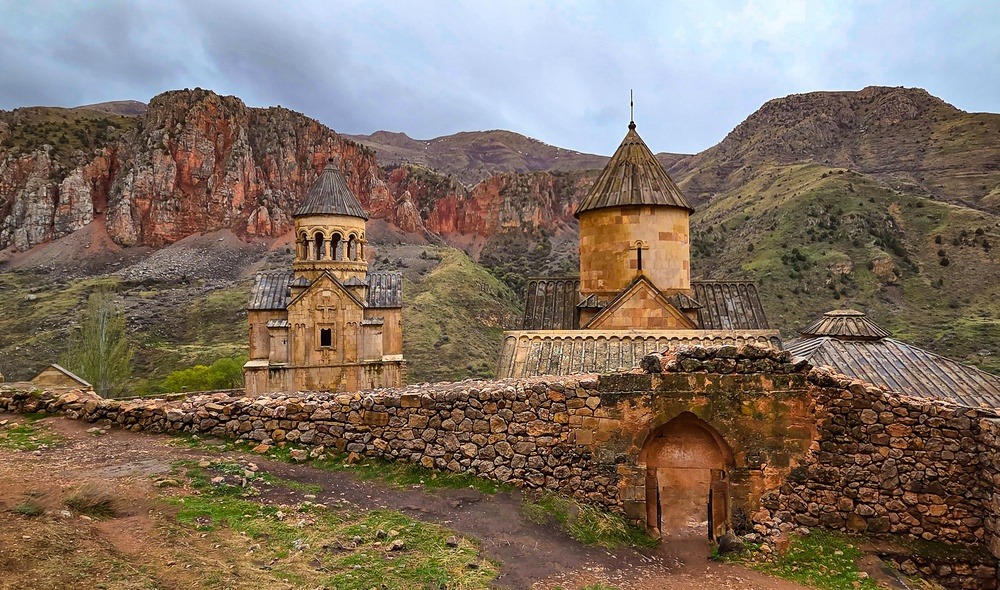
Gegharkunik is also a repository of medieval Armenian heritage. On the peninsula pointing northward, the Sevanavank monastery, founded in 874 by Princess Mariam, stands at the top of a staircase of 200 steps. The two churches of black tuff, Sourp Arakelots and Sourp Astvatsatsin, display a sobriety found throughout 9th-century architecture. About fifty kilometers away, the Noratus cemetery lines up nearly 900 khachkars, those funerary stelae carved as crosses between the 9th and 17th centuries. It is the largest khachkar field preserved in Armenia since the destruction of the one in Julfa in Nakhchivan in the 2000s.
Beyond the well-known sites, the province holds a few detours we recommend depending on the length of your stay. The Hayravank monastery, perched on a basalt outcrop above the lake, offers a quieter stop than Sevanavank. The village of Martuni, on the southern shore, provides access to the high-altitude meadows of the Geghama massif and its prehistoric petroglyphs, carved between 5,000 and 2,000 years before our era on volcanic stones between 3,000 and 3,200 meters. Further east, toward Vardenis, the steppe empties and already hints at Karabakh, or rather what remains accessible there today.
Local cuisine is marked by the lake and high altitude: grilled or oven-baked ishkhan in tomato sauce, boiled crayfish sold roadside between July and September, potato kyufta, cheeses from Geghama shepherds. The markets of Gavar, the provincial capital, remain frequented mainly by locals, which makes them a good stop for understanding the region's actual economy, built on fishing, livestock raising, and small-scale potato cultivation.
We rarely treat Lake Sevan as a standalone destination. It is rather a hinge between the forested north (Dilijan, Tavush) and the arid south (Vayots Dzor, Syunik). One or two nights are enough to grasp its spirit, provided you leave the M4 and follow the eastern or southern shore, much quieter than the surroundings of the peninsula.
To discover
Sevanavank monastery on the peninsula. Climb 200 steps up to the two 9th-century black tuff churches, with views over the blue expanse of the lake and the Areguni ridges in the background.
Noratus khachkar cemetery. Nearly 900 stelae carved between the 9th and 17th centuries, lined up on a hillside meadow. The village shepherdesses sometimes offer their wool socks at the entrance.
Ishkhan and crayfish by the lake. Between July and September, restaurants in Tsapatagh and on the southern shore serve the endemic trout grilled and crayfish boiled fresh from the morning catch.
Petroglyphs of the Geghama massif. A day-long 4x4 excursion from Sevan or Geghard toward 3,000 meters altitude, to prehistoric rock carvings on volcanic stones. Accessible only from June to September.
Hayravank monastery above the lake. A small ensemble from the 9th-12th centuries perched on a basalt outcrop on the western shore, usually deserted, with an open view over the lake and fishing villages.
When to go
The best period for Lake Sevan extends from mid-June to mid-September. In July and August, the water reaches 18 to 20°C, air temperatures oscillate between 22 and 26°C during the day and drop back to around 12°C at night. This is the only time swimming is feasible and when high-altitude roads to the Geghama petroglyphs are passable. September is a good window for those wanting to avoid the crowds of Armenian families: the shores empty out once the school year begins, the light becomes more slanted, and crayfish remain on the menu.
From November to April, the province freezes over. Temperatures regularly drop below -10°C in January, portions of the lake freeze, and some lakeside hotels close. A quick stop at Sevanavank remains possible year-round from Yerevan, but we advise against an extended stay between December and March, unless you have a specific interest in winter landscapes. May and early June are pleasant for cultural sites (monasteries, khachkars) but the water remains too cold for swimming, around 10 to 12°C.
Practical advice
One to two nights are enough to cover the essentials of Lake Sevan: Sevanavank, Noratus, Hayravank, and a meal by the lake. The province is easily traversed by car from Yerevan (70 km, 1.5 to 2 hours depending on traffic). Hotel comfort is uneven: a few decent options on the northwestern shore and around Tsapatagh on the eastern shore, quieter and better exposed. We systematically avoid large Soviet-era complexes hastily renovated near the peninsula.
Lake Sevan connects well with Dilijan and Tavush to the north, an hour's drive via the Sevan Pass tunnel, or a descent toward Vayots Dzor and Noravank to the south, in two and a half hours. For a classic 10- to 12-day circuit in Armenia, we generally insert it midway through the itinerary, after Yerevan-Ararat and before Vayots Dzor then Syunik-Tatev. The region suits contemplative travelers, lovers of medieval architecture, and summer hikers wanting to access the Geghama plateau. It is less suited to families seeking structured beach activities: the water remains cool and beach amenities are basic.