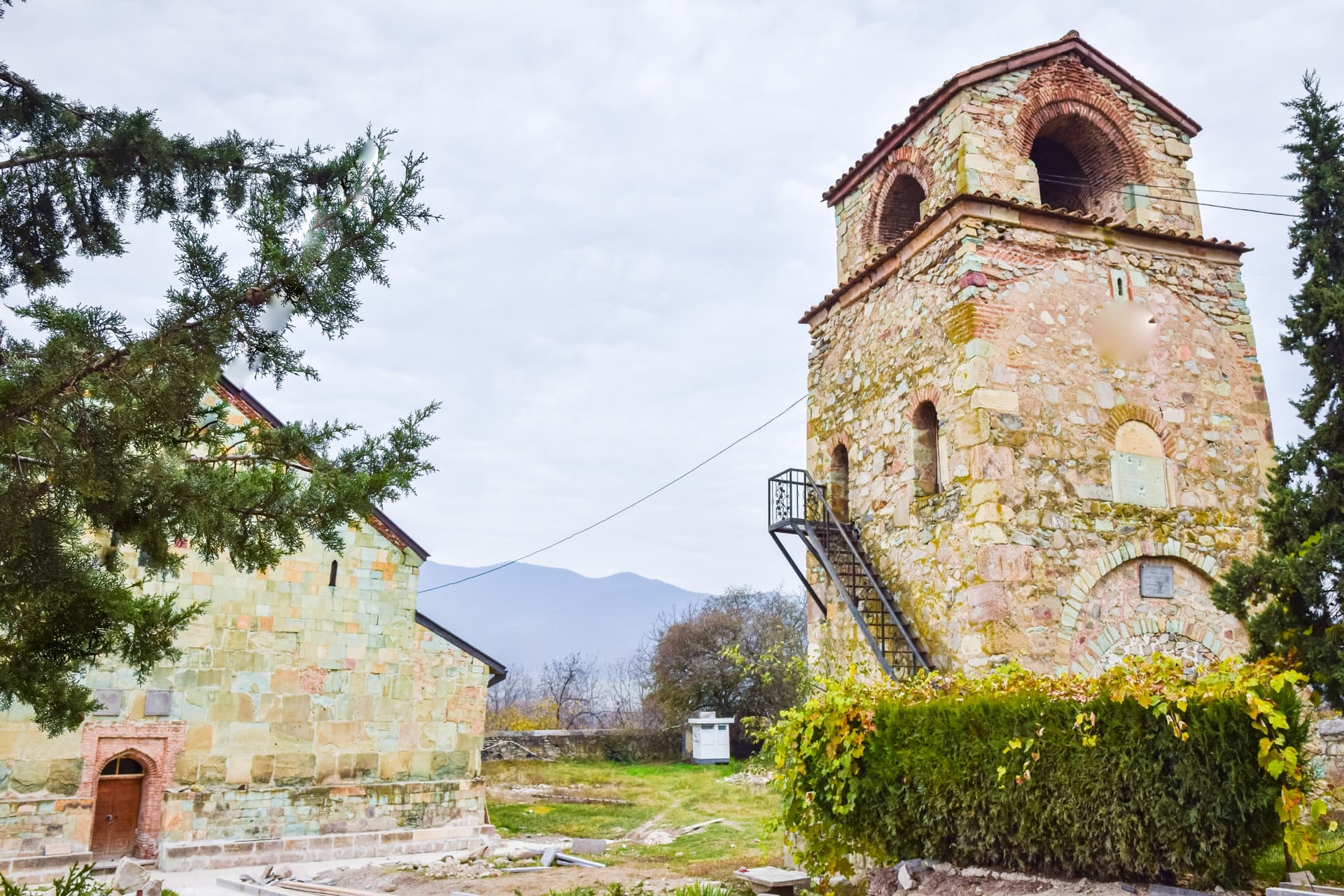
Bolnisi Sioni
Bolnisi Sioni
A 5th-century Georgian basilica near Tbilisi, Bolnisi Sioni preserves some of the oldest inscriptions in the Georgian alphabet and the famous Bolnisi cross.
Bolnisi Sioni (ბოლნისის სიონი) is one of Georgia's oldest great basilicas, erected in the late 5th century in the Kvemo Kartli region. Modest in outward appearance, this building contains inside some of the oldest inscriptions in the Georgian alphabet, along with sculptural decoration that makes it a major witness to primitive Christian architecture in the Caucasus.
Why visit Bolnisi Sioni
The basilica holds a rare distinction: it combines an active liturgical function (it remains under the jurisdiction of the Catholicate-Patriarchate of all Georgia) with first-rate archaeological significance. The inscriptions carved above its entrances rank among the oldest known testimonies to Georgian writing, making it a milestone in the country's cultural history.
Unlike heavily visited monastic sites, Bolnisi Sioni remains off the major tourist circuit. Visitor numbers stay moderate, allowing for close observation of the architecture and carved decoration without crowds.
History of the basilica
The building is attributed to the reign of King Vakhtang Gorgasal, with construction dated between 478 and 493. It belongs to the first wave of monumental Georgian churches, at a time when Christianity was taking root amid political and religious pressures from the Sassanid empire.
Among the many basilicas of this type erected in the late 5th century across the country, Bolnisi Sioni is one of the very few to survive the centuries. In the 17th century, Queen Mariam Dadiani commissioned several modifications to the complex. The original roof has not been preserved; the current covering is modern.
The inscriptions carved above the entrances, which mention "Bishop Daniel and King Péroz," constitute one of the oldest known corpora in the Georgian alphabet. They are studied as a reference by historians of language and epigraphy.
Architecture and elements to see
The plan follows the three-nave basilica model, with an altar lacking a dome, which distinguishes Bolnisi Sioni from later Georgian churches with a centralized plan. The interior rests on five cruciform pillars, and the walls are lined with smooth turquoise slabs characteristic of local stone.
Several details merit close observation:
- The Bolnisi cross, placed on the right pillar of the altar, an emblematic motif later adopted on the national flag.
- The ancient Georgian inscriptions above the entrances, mentioning Bishop Daniel and King Péroz.
- Sculpted columns decorated with geometric motifs, birds, and animals.
- The baptistery, adorned with a peacock and bull heads, rare decorative elements in this type of building.
The exterior is deliberately austere: it is the interior that concentrates the iconographic richness.
Practical information
- Location: near the town of Bolnisi, in the Kvemo Kartli region, south of Tbilisi.
- Duration of visit: allow 30 to 60 minutes on-site, longer if you combine it with the Bolnisi museum or nearby sites.
- Dress code: this is an active Orthodox church. Shoulders and legs should be covered; a scarf is recommended for women (often available at the entrance).
- Fee: free admission.
- Photography: generally permitted outside; inside, it's best to ask first.
To see in the surrounding area
The Bolnisi Museum
The local museum houses a collection spanning from the Neolithic to the medieval period: bronze axes, ceramics, ancient inscriptions, and a fossilized tree. A useful stop for placing the basilica in its regional context.
The Church of Tsughrughasheni
Located a few kilometers away, this domed church, of later date, features a finely sculpted dome. Its inscriptions mention King George and builder Hasan. The contrast with Bolnisi's dome-less basilica illustrates the stylistic evolution of Georgian churches.
Chapala Fortress
Perched on a rocky hill near the village of Chapala, it preserves remains of buildings and water reservoirs. The surrounding lands, cultivated by the local Azerbaijani community, provide a glimpse of Kvemo Kartli's ethnic mosaic.
To continue exploring ancient Georgia, you can visit the Dmanissi archaeological site, located in the same region, or the cave city of Uplistsikhe to the northwest.
How to get there
Bolnisi Sioni is located about 60 km southwest of Tbilisi. Several options:
- By car: allow 1 to 1.5 hours from Tbilisi depending on traffic. This is the most flexible option, especially for combining nearby sites.
- By marshrutka (minibus): regular connections from Didube station in Tbilisi to Bolnisi, then local taxi to the basilica (the building is located outside the town center).
- By organized tour: many circuits in southern Georgia include Bolnisi with Dmanissi or Tsughrughasheni.
Frequently asked questions
Frequently asked questions
Include Bolnisi in your itinerary
Bolnisi Sioni fits naturally into a circuit in southern Georgia, with Dmanissi, Tsughrughasheni, and the wine regions of Kvemo Kartli. To build a tailor-made journey incorporating this heritage region, explore our Georgia travel ideas.
Interested in this visit?
We can include it in your personalised itinerary.