Dmanissi Archaeological Site
Dmanissi Archaeological Site
Located 85 km from Tbilissi, Dmanissi superimposes a medieval city and a paleoanthropological site yielding human remains dated to 1.8 million years ago.
Approximately 85 km southwest of Tbilissi, the Dmanissi archaeological site occupies a promontory situated at the confluence of the Mashavera and Pinesaouri rivers, in the Lower Kartli (Qvemo Qartli) region. Beneath the remains of a medieval city, excavations have uncovered human remains dated to 1.8 million years ago, among the oldest known outside Africa.
Why visit Dmanissi
The site condenses two layers of history rarely found in a single location. On the surface, a Georgian medieval city with its 7th-century basilica and the ruins of a fortress. Underground, a major paleoanthropological site that has yielded five hominid skulls and more than 8,000 stone artifacts, dated to approximately 1.85 million years ago. Dmanissi has been on UNESCO's indicative list of world heritage sites since 2007 (the site is not yet inscribed). It is one of the most instructive stops to make from Tbilissi for those interested in archaeology or prehistory.
History of the site
Dmanissi has been inhabited since the early Bronze Age. In the medieval period, the locality becomes a waypoint on the Silk Road connecting the Black Sea to the Caspian. The original toponym, Bashkechit (Azerbaijani), was replaced by Dmanisi when the town fell under Arab influence. The first written mention dates back to the 9th century, as a possession of the Emirate of Tbilissi.
During the Middle Ages, Dmanissi thrives as a commercial hub before undergoing successive occupations by the Seljuk Turks, Arabs, Turkomans and Mongols. The city is nearly abandoned around 1700.
Archaeological excavations begin in 1936. In 1983, paleontologist Abesalom Vekua identifies a rhinoceros tooth Dicerorhinus etruscus in ancient grain storage pits, allowing the Lower Pleistocene layer to be dated. The following year, stone tools are extracted from the site. Between 1991 and 2005, David Lordkipanidze's team unearths a maxillary bone dated to 1.8 million years ago, then two skulls in 1999 and 2001. The remains, initially attributed to Homo georgicus, are now classified as Homo erectus georgicus. In 2013, a fifth skull morphologically distinct from the previous ones underscores the variability of the species.
What to see on site
The Dmanissi museum-reserve
The museum displays part of the collections from the excavations: casts of hominid skulls, prehistoric animal bones, stone tools. The original remains of the five skulls (two adults, one toothless aged individual, a pre-adult and an adolescent) are preserved in the National Museum of Tbilissi.
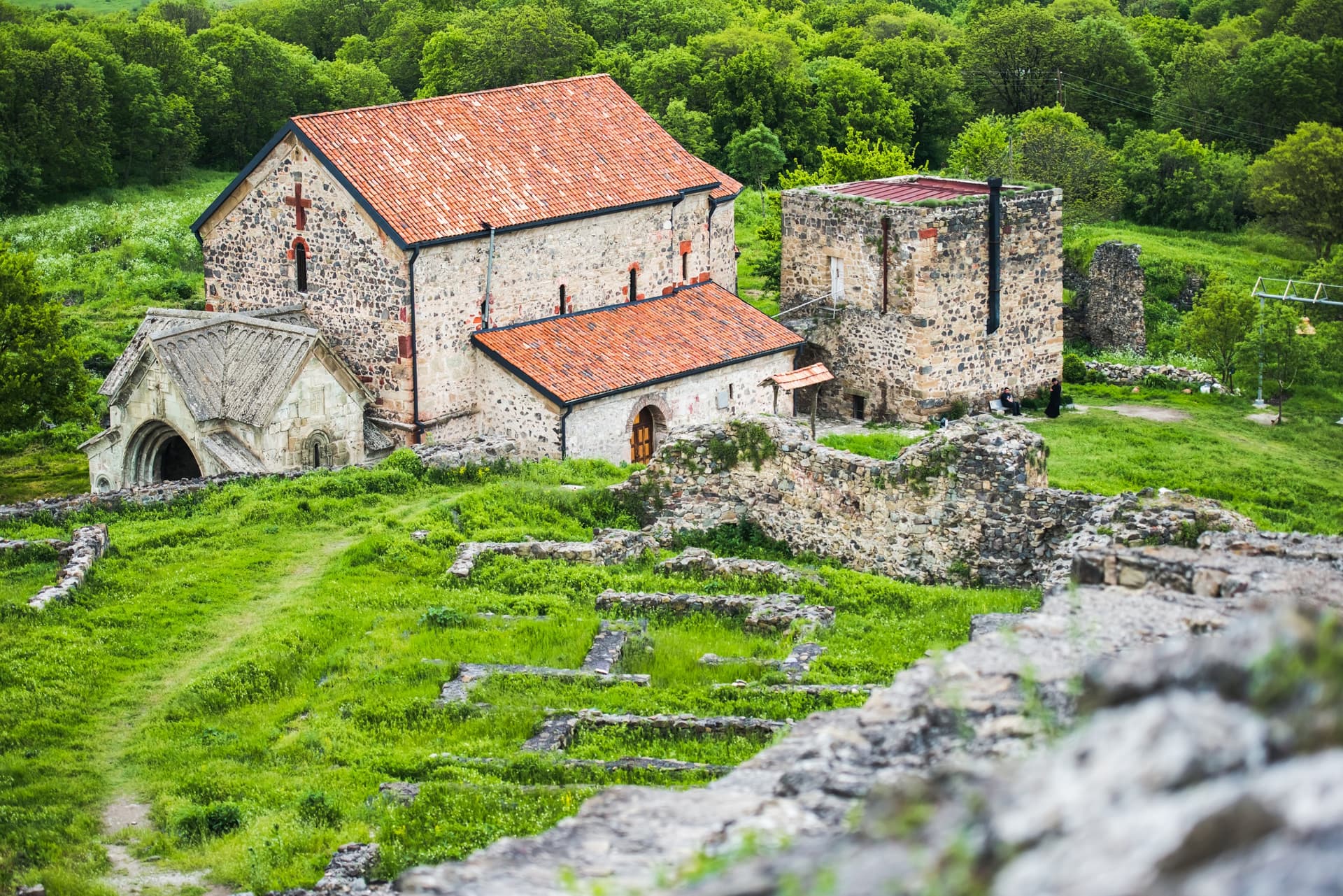
The Dmanisis Sioni basilica
Built in the 7th century at the foot of the city, this Orthodox basilica is adorned with frescoes depicting Georgian saints. It remains partially preserved and testifies to the religious importance of the site in the Middle Ages.
The fortress and medieval city
The remains of the castle and fortifications dominate the rocky spur. One can still discern the layout of streets, cisterns and defensive structures. Beneath these ruins, the Paleolithic layers were identified.
The paleoanthropological site
Part of the excavations remains visible, with explanatory panels on stratigraphy and successive discoveries.
Practical information
- Duration of visit: allow 2 to 3 hours to tour the museum, basilica, fortress and site.
- Entrance fee: moderate entrance, combined ticket museum + site.
- Accessibility: the site is explored on foot on sloped terrain, wear suitable footwear.
- Services: no dining on site, bring water and snacks.
When to go
The site is open to the public from March to November. The basilica and fortress ruins remain visible year-round, but excavation zones and the museum close off-season. May-June and September-October offer the most pleasant conditions, with mild temperatures and favorable light. Summer can be hot and dry on the plateau.
How to get there
Dmanissi is located approximately 85 km southwest of Tbilissi.
- By car: this is the most practical option. Allow approximately 2 hours driving time from central Tbilissi. The road has undergone rehabilitation works and access to the site is now clearly signposted.
- By minibus: a minibus departs daily from Didube bus station in Tbilissi heading to Dmanissi. The journey takes approximately 4 to 5 hours. Check return schedules before departing, as frequency is limited.
- By organized tour: several agencies in Tbilissi offer day trips, often combined with other Lower Kartli sites.
What to combine nearby
The Lower Kartli region and southern Georgia offer several complementary stops:
- Sion of Bolnisi, one of Georgia's oldest basilicas, located nearby.
- Uplistsikhe, a cave city carved into the rock.
- Alaverdi Cathedral in Kakheti, to extend your medieval architectural itinerary.
Frequently asked questions
Frequently asked questions
Dmanissi has been on UNESCO's indicative world heritage list since 2007, but is not yet officially inscribed. The candidacy remains under review.
Yes. By car, the round trip with a 2 to 3 hour visit on site fits comfortably within a day. By public transport, organization is more constrained by minibus schedules.
These are hominids dated to approximately 1.8 million years ago, of which five skulls have been uncovered between 1991 and 2013. Initially named Homo georgicus, they are today classified as Homo erectus georgicus and represent the oldest known human remains outside Africa.
The museum-reserve and excavation zones are accessible between March and November. The exterior ruins (basilica, fortress) remain visible off-season, but without guidance.
Prepare your trip
Dmanissi naturally fits into an itinerary centered on Tbilissi and southern Georgia. To build a custom itinerary including this site and other archaeological stops in the country, consult our Georgia trips.
Interested in this visit?
We can include it in your personalised itinerary.