Ziwa Rhino Sanctuary
Ziwa Rhino Sanctuary
Uganda's only site where you can encounter white rhinos on foot, midway between Kampala and Murchison Falls National Park.
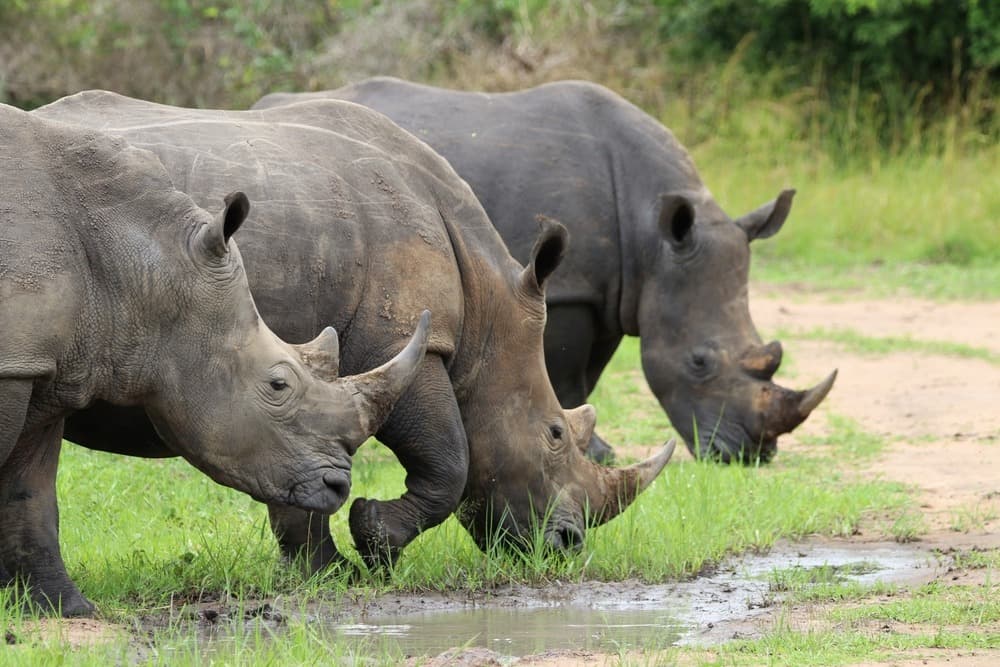
The Ziwa Rhino and Wildlife Ranch, more commonly known as Ziwa Rhino Sanctuary, is Uganda's only sanctuary where Southern white rhinos roam in a semi-wild state. Located midway between Kampala and Murchison Falls National Park, it makes a logical stop for travellers heading north.
Why visit Ziwa
Ziwa is Uganda's only site where you can approach rhinos on foot, accompanied by a ranger. Beyond this encounter, the ranch protects over 300 bird species, and the adjacent Lugogo Swamp is home to the shoebill, a rare wading bird with a prehistoric silhouette. The diversity of activities—hiking, canoeing, night walks, birdwatching—allows you to spend anywhere from half a day to two days depending on your pace.
A story of reintroduction
Rhinos had completely disappeared from Uganda in the early 1980s, victims of poaching and conflict. Ziwa Sanctuary was established in 2005 with a clear objective: rebuild a Southern white rhino population destined for later reintroduction into Uganda's national parks.
The venture began with six founder animals: four purchased from Solio Ranch in Kenya and two donated by Disney's Animal Kingdom in Florida. Births followed in succession: thirteen individuals by 2013, twenty-two by 2018, thirty-three by late 2021. Recent figures fluctuate depending on sources and ongoing transfers, but the population continues to grow.
Protection measures are substantial: more than 80 rangers patrol day and night, and a two-metre-high electric fence encircles the entire 70 km² domain.
What to see and do
Hiking with the rhinos
The flagship activity involves tracking rhinos on foot, accompanied by an armed ranger. Depending on where the animals are in the reserve, you first reach the zone by vehicle, then complete the approach on foot through savanna, acacia woodland and marsh edges. A safety distance of six to seven metres is maintained, sufficient to observe and photograph without disturbing them. Outings take place early morning or late afternoon, when animals are most active. Bring closed shoes, long trousers, and plenty of water.
Lugogo Swamp and the shoebill
Lugogo Swamp, bordering the ranch, is one of Uganda's rare sites where you may encounter the shoebill, a large wading bird with a massive bill that feeds on fish, young crocodiles and monitor lizards. Outings are by canoe, ideally at dawn. Binoculars, cap and sunscreen are essential.
Birdwatching
Over 300 bird species have been recorded on the property. Four marked trails cross marshes, savanna and wooded areas, each offering different birdlife. The first and last hours of the day are most productive.
Night walk
In the evening, guided outings allow you to observe nocturnal species rarely visible during the day: civets, galagos, night birds. Plan for one to three hours of walking depending on the chosen route. Good fitness, a headlamp and mosquito repellent are necessary.
When to go
The dry seasons, December to February and late June to October, are most favourable for hiking: trails are passable, animals concentrate around watering holes, and skies are clear.
More humid periods (March-May and September-November) green the landscapes and coincide with peaks in birdwatching activity, notably the arrival of migrant species. Rain showers are rarely persistent and rarely prevent outings.
Practical information
- Several activities are priced separately (entry, rhino hike, shoebill outing, birdwatching walks). Rates vary: check at the time of booking.
- Outings run on fixed time slots at the beginning and end of the day. Night walks take place in the evening and last one to three hours.
- Accommodation available on site (camping and lodges) to combine morning hikes and evening walks.
- Useful equipment: closed hiking shoes, long trousers, insect repellent, binoculars, headlamp, water.
How to get there
The sanctuary lies 175 km from Kampala, roughly two to three hours' drive depending on traffic. The route follows the Gulu highway to the turning marked by the Nakitoma sign, from where a track leads to the sanctuary entrance. Ziwa fits naturally into an itinerary towards Murchison Falls National Park, situated about three hours further north.
Nearby and extensions
For travellers combining Uganda and neighbouring Rwanda, several sites complement an East African itinerary centred on wildlife and remembrance:
- Lake Ihema, within Akagera Park, to observe hippos and water birds.
- Lake Kivu, a vast lake bordered by volcanic beaches.
- Kigali Genocide Memorial, an essential stop for understanding contemporary Rwanda.
- The village of Mbyo, village of reconciliation, which extends this reflection through human encounter.
Plan your trip
Ziwa Sanctuary integrates naturally into a wildlife circuit in East Africa. To build a bespoke itinerary including primates, savannas and great lakes, consult our Rwanda journeys and their extensions into neighbouring Uganda.
Interested in this visit?
We can include it in your personalised itinerary.