Geghard Monastery
Geghard Monastery
40 km from Yerevan, the UNESCO-listed cave monastery of Geghard combines cliff-carved chapels, medieval relics, and the Azat valley.
About 40 kilometers southeast of Yerevan, Geghard Monastery occupies a singular setting: its chapels are partially carved into the cliff face, at the entrance to the Azat valley. The complex, listed as a UNESCO World Heritage site since 2000, exemplifies medieval Armenian monastic architecture and preserves a layered memory of historical events and Christian traditions.
Why visit Geghard
The name Geghardavank means "monastery of the lance," referring to the relic of the Holy Lance that is said to have been preserved here for centuries before being transferred to Etchmiadzin. Local tradition also mentions the presence of a supposed fragment of Noah's Ark, an element of popular devotion that contributed to the site's renown in the Middle Ages.
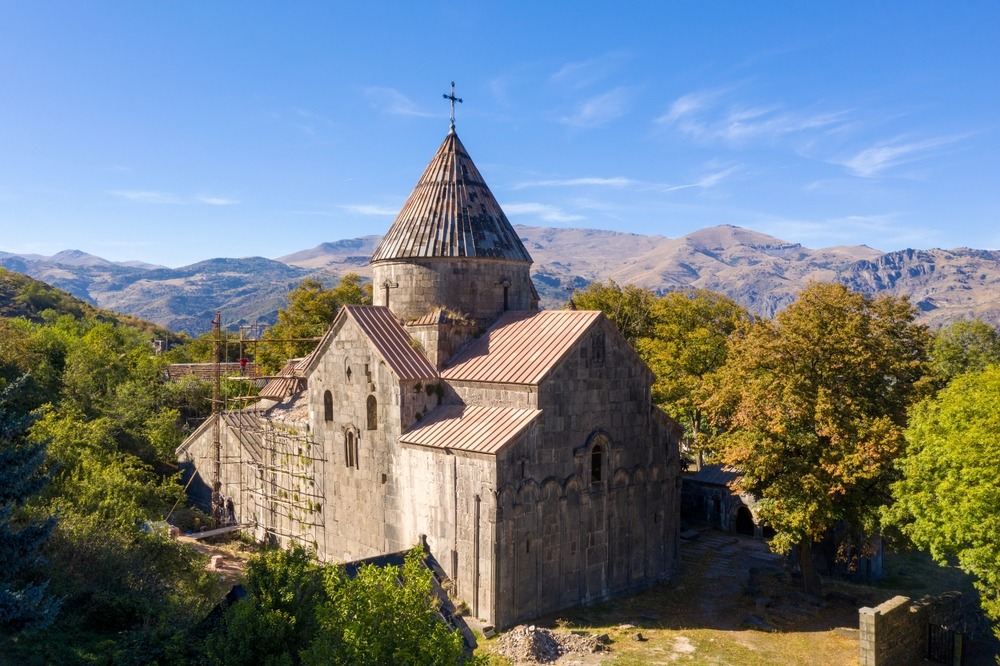
Beyond these relics, the site's interest lies in its integration with the rock. Several churches, the gavit, and certain chapels are carved directly into the cliff face, while other buildings are constructed of hewn stone. The ensemble forms a coherent complex where places of worship, funerary halls, and former hermitage spaces interweave.
History
The monastery was originally named Airivank, "rock monastery." Historians place its foundation between the 7th and 8th centuries, while local tradition traces it back to the 4th century, the era of Armenia's Christianization. Saint Gregory the Illuminator and catholicos Sahak Pathev are said to have stayed here, anchoring the site in the foundational memory of the Armenian Church.
In 920, the monastery was pillaged by Arab regent Nasr. It was not until the 13th century and the princely Prochian family that the site was refounded in its present form. The main church Kathoghike was built in 1215, followed by the rock-hewn chapels in 1225. The complex then housed the Holy Lance and the fragment attributed to Noah's Ark, becoming a major pilgrimage destination.
Geghard subsequently suffered Mongol invasions and the campaigns of Timur, and three major earthquakes (1127, 1679, 1847) damaged its buildings. Each time, the monastery was rebuilt, a sign of its religious importance to successive dynasties.
What to see on site
The Kathoghike Church
Built in 1215, it is the main building of the complex. Its façade and drum are sculpted with geometric and floral motifs. Inside, you will notice the effigy of a bull symbolizing the supremacy of Ivane Zakarian, the monastery's first benefactor under the Prochians.
The Rock-hewn Church of Avazan
Entirely carved into the rock, this church houses a spring considered healing by local tradition. Visitors stop here to taste the water, in a space where acoustics amplify the faintest chant.
The Saint Astvatsatsin Chapel
This small chapel preserves sculptures and reliefs characteristic of medieval Armenian art. Its modest size contrasts with the care lavished on its decoration.
Hermit cells and khachkars
Along the cliff face, hermit cells are accessible only by ropes or ladders: they bear witness to the ascetic life practiced on the site before and during the monastic period. Around the complex, several khachkars (finely carved Armenian stone crosses) punctuate the landscape.
Practical information
Monastery entry is free. Geghard is an active place of worship: appropriate dress is requested, with shoulders and knees covered, and voices kept low inside the chapels. Plan on 1 to 2 hours to tour the complex at a leisurely pace, longer if you extend with a walk around the cliffs.
At the entrance, stalls run by local women offer regional products. Try gata, a traditional pastry with sweet filling, often baked in a tonir (Armenian oven) nearby. A local custom holds that you should toss a small stone toward natural cavities in the rocks at the entrance: if it lodges, your wish will come true.
When to visit
From May to October, the climate is dry and the road remains easily passable. May-June and September offer mild temperatures and moderate crowds. In the height of summer, plan to visit in the morning to avoid heat and tour groups.
Winter transforms the site: snow highlights the stone façades and contrasts with the cliffs, but roads may be icy and some parts of the complex harder to access. Early morning light cast across the Azat valley is especially conducive to photography.
How to get there
Geghard is located about 40 km from Yerevan, in the Kotayk region. The regional road leading there passes through the village of Garni, making it easy to visit both sites in a single day.
- By taxi: the simplest option from Yerevan, with waiting time included. Negotiate a round-trip fare with a stop in Garni.
- By marshrutka: minibuses depart from Gai station in Yerevan toward Garni; from Garni, you'll need to supplement with a taxi or hitchhike for the final kilometers.
- By organized excursion: many agencies offer a day-long Garni + Geghard combination.
Nearby
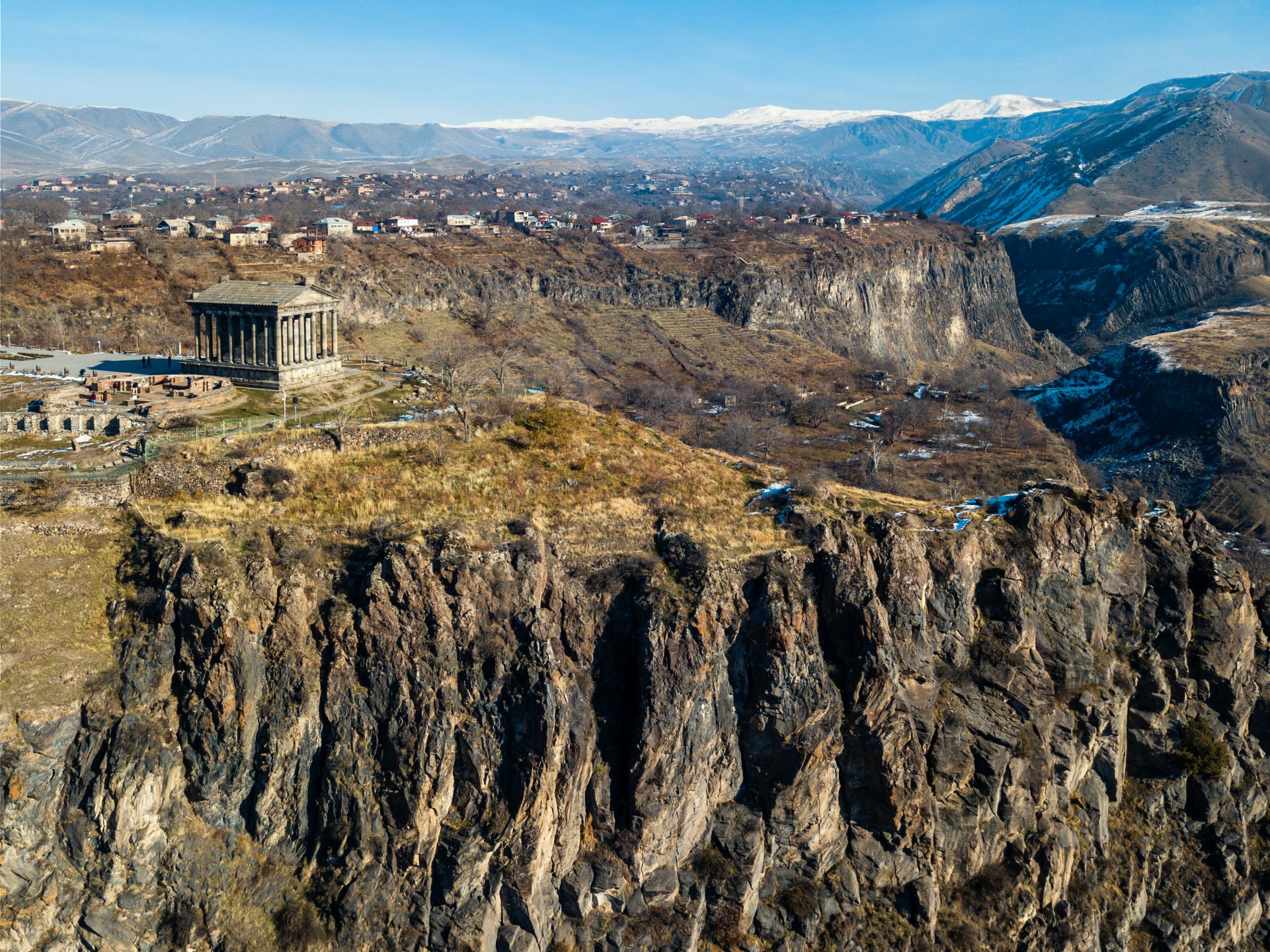
- Garni Temple: 10 km away, the only surviving Greco-Roman temple in Armenia, routinely paired with a visit to Geghard.
- Hovannavank Monastery: another example of medieval Armenian monastic architecture, north of Yerevan.
- Armenian Genocide Memorial: in Yerevan, a memorial moment to integrate into your time in the capital.
Frequently asked questions
No. The relic said to have pierced Christ on the cross and to have given the monastery its name is today preserved in the museum of the catholicossal see of Etchmiadzin, near Yerevan.
Inscribed in 2000, the site is recognized for its partially rock-hewn monastic architecture from the 13th century, exceptional in the Caucasus, and for its integration into the landscape of the Azat valley.
Plan for 1 to 2 hours on site. Combined with Garni Temple, allow a half-day to a full day from Yerevan.
No, these historic cells are accessible only by rope or ladder and are not open to visitors. They can be observed from the path that runs alongside the complex.
Geghard is an active monastery: covered shoulders and knees are expected inside the churches. Women sometimes prefer to cover their hair, though this is not required for female visitors.
Extend your stay
Geghard naturally fits into an itinerary combining Yerevan, the Azat valley, and the great monasteries of the north. To build a custom trip and pair this site with other highlights of the country, consult our suggestions for itineraries in Armenia.
Nearby
Interested in this visit?
We can include it in your personalised itinerary.