Tatev Monastery
Tatev Monastery
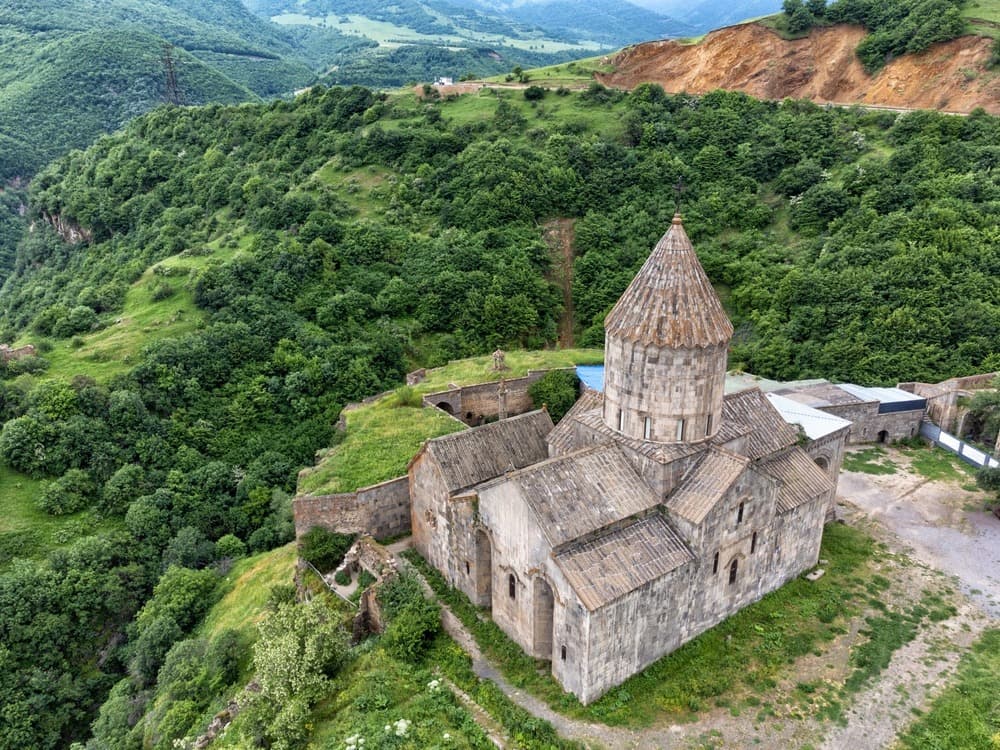
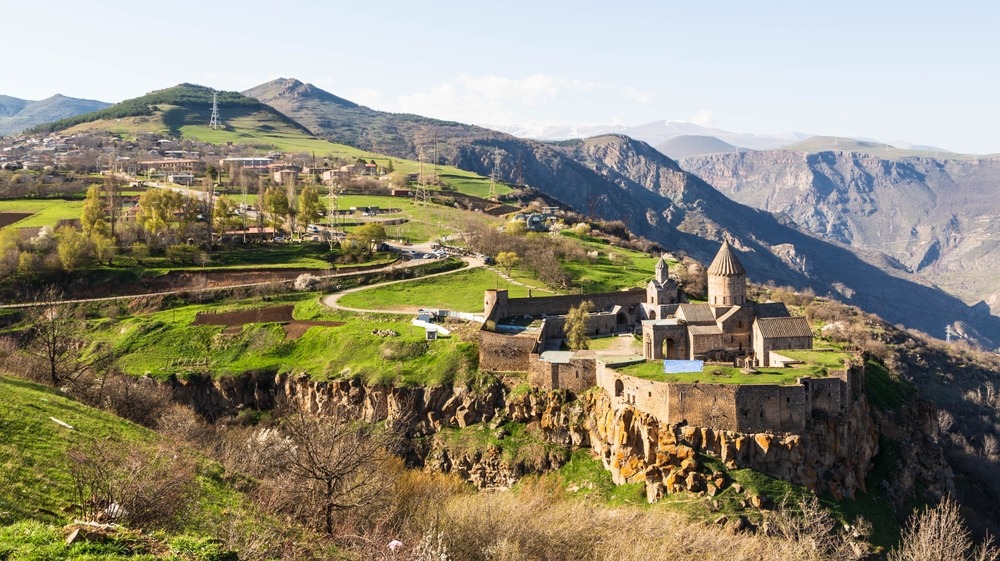
Founded in the 9th century in Syunik province, Tatev Monastery overlooks the Vorotan gorge and was one of the great intellectual centers of medieval Armenia.
Tatev Monastery stands on a basalt plateau above the Vorotan River gorge, in Syunik province, southeastern Armenia. Founded in the 9th century, it was one of the country's great spiritual and intellectual centers during the medieval period, housing at its height a university whose influence extended throughout Armenia.
Why visit Tatev Monastery
- A 9th-century monastic complex ranked among Armenia's most important, comparable to Noravank in the neighboring Vayots Dzor province.
- A site perched on the edge of a gorge roughly 500 meters deep, accessible by the "Wings of Tatev" cable car, listed in the Guinness World Records.
- Three medieval churches and several ancillary structures (library, refectory, bell tower, wine press, Gavazan pendulum) that testify to monastic life between the 10th and 14th centuries.
- The seat of the former Tatev University, a center for science, philosophy, theology and miniature painting in the 14th century.
History
The monastery was founded in the 9th century. Its consecration took place in the presence of King Smbat I Bagratuni and several catholicos, testifying to its importance from the start. Land donations allowed the site to develop rapidly and establish itself as the episcopal seat of the Syunik region.
In 1138, an earthquake destroyed the dome of the Church of Saints Peter and Paul and damaged the Church of Saint Gregory the Illuminator. In 1170, the monastery was pillaged by Seljuk Turks: the library was destroyed and several thousand manuscripts disappeared.
Restoration took place in the mid-13th century under the impetus of princes Smbat and Tarsaich Orbelian, who restored the site's religious and cultural role. In the 14th century, Tatev University was established here and became a recognized center of learning in science, philosophy and theology. The monks also continued manuscript copying and miniature painting.
The complex is today undergoing extensive conservation work as part of the Tatev Renaissance Program, a contemporary initiative for the restoration and enhancement of the site and its surroundings.
What to see on site
Church of Saints Paul and Peter
Built between 895 and 906, it is the monastery's oldest church. Its rectangular plan is completed by an apse flanked by vaults and a dome resting on pillars. The niches on the eastern facade bear bas-reliefs representing the monastery's main benefactors.
Church of Saint Gregory the Illuminator
Built against the south wall of the main cathedral, this church presents a sober design. Geometric sculptures ornament its entrance, and pillars support the inclined arches of the roof.
Church of the Holy Mother of God
Erected in 1087 on the upper level of an ancient mausoleum, this church stands along the northern fortifications. Damaged by the 1931 earthquake, it was restored at the end of the 20th century. Its dome remains one of the architectural landmarks of the complex.
Other buildings and structures
The complex also includes the library, refectory, bell tower and mausoleum of Gregory of Tatev. Inside the enclosure, the vertical Gavazan pendulum, built in the 10th century, is a unique architectural curiosity. Outside the fortifications, an olive press evokes the monastery's economic self-sufficiency. The walls and buildings dedicated to monks and students reflect the site's daily organization across different periods.
Practical information
- Duration of visit: allow 1h30 to 2h30 to tour the monastic complex, longer if combined with the cable car and stops along the way.
- Admission: free entry to the monastery; the cable car is paid; budget a modest amount for a round trip.
- Dress code: shoulders and knees must be covered inside the churches, in accordance with Armenian religious site customs.
- Hours: the monastery is open all day; the cable car operates during daylight hours with a weekly closure to verify on site.
When to visit
The site sits at altitude and Syunik's climate experiences significant seasonal variations. The most favorable period runs from late May through early October, when mountain roads are clear and the cable car operates in good conditions. In summer, temperatures remain pleasant on the plateau. Autumn offers particularly sharp light over the Vorotan gorge. In winter, snow may complicate access and the cable car may be interrupted during windy episodes: check conditions before traveling.
How to get there
Tatev is located about 250 km south of Yerevan. The route passes through Goris, the last major city before the monastery, and is a frequent overnight stop for travelers. From Goris, two options:
- By cable car: reach the village of Halidzor (about 15 km from Goris), then board "Wings of Tatev," a cable car listed in the Guinness World Records as the world's longest reversible aerial ropeway without intermediate stops, which crosses the Vorotan gorge to the monastery.
- By road: a winding mountain road descends into the Vorotan River canyon, about 500 meters lower, passes near the Devil's Bridge and thermal springs, then climbs back to the plateau and the monastery. The drive takes about an hour from Goris.
Organized excursions from Yerevan allow you to visit Tatev in a full day, often combined with other sites in the province.
Nearby
- The village of Tatev: located on the same plateau, it offers a glimpse of rural life in southern Armenia.
- Devil's Bridge: a natural formation at the bottom of the Vorotan gorge, accompanied by small thermal springs, on the route from Halidzor.
- Goris and Khndzoresk: Goris serves as a logistics base, and the troglodytic village of Khndzoresk, accessible by a suspension bridge, is about thirty kilometers away.
- Noravank Monastery: en route between Yerevan and Tatev, in Vayots Dzor province, another major medieval monastic complex.
- Garni Temple: combine if heading back to Yerevan, the only preserved Greco-Roman temple in Armenia.
Frequently asked questions
Frequently asked questions
Allow 1h30 to 2h30 on the site itself. If you take the cable car round trip from Halidzor, plan for a half-day. An excursion from Yerevan requires a full day.
The cable car operates year-round in principle, but may be interrupted in strong winds, particularly in winter. A weekly maintenance day is also scheduled. Check conditions before your visit.
Yes. A mountain road descends into the Vorotan gorge, passes the Devil's Bridge and climbs to the monastery. The route is winding and longer, but offers spectacular views over the gorge.
Yes. Tatev remains a place of worship of the Armenian Apostolic Church and is part of a contemporary restoration program, the Tatev Renaissance Program.
Along the Yerevan-Tatev route, Noravank Monastery is a natural stop. Around Goris, the troglodytic village of Khndzoresk and Devil's Bridge complement discovery of Syunik province.
Include Tatev in your journey
Tatev Monastery fits easily into an itinerary connecting Yerevan with southern Armenia, with stops at Noravank, Goris and Khndzoresk. To build a tailor-made route, consult our Armenia travel packages and connect with our local specialists.
Interested in this visit?
We can include it in your personalised itinerary.