Khndzoresk
Khndzoresk
An ancient troglodytic village in southern Arménie near Goris, Khndzoresk reveals itself through its sculpted gorge, medieval churches and a 160-metre suspension bridge.
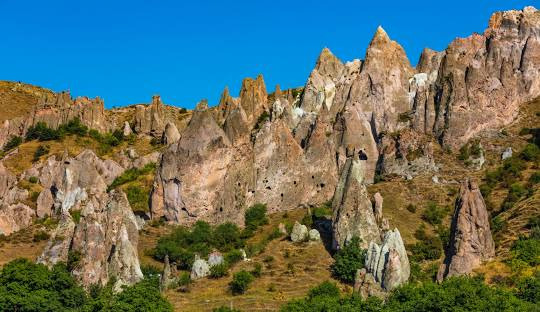
Khndzoresk is an ancient troglodytic village in the Syunik region of southeastern Arménie, about ten kilometres from Goris. Carved into a gorge with rocky walls sculpted by erosion, it was inhabited until 1950 and is believed to have housed up to 15,000 people at its peak. Today, its caves, medieval churches and suspension bridge make it one of the most memorable stops on the road to Tatev.
Why visit Khndzoresk
The site combines three rarely brought together interests: a troglodytic habitat of considerable scope, medieval religious heritage (two churches and a church-school) and a spectacular natural setting formed by the fairy chimneys of the gorge. Crossing the 160-metre suspension bridge, inaugurated in 2012, adds a panoramic dimension that complements the visit perfectly.
Khndzoresk also carries a strong historical significance: it was here that David Bek and his commander Mkhitar Sparapet led their resistance against the Ottomans and Safavids in the 18th century. The village preserves several tombs and monuments linked to this period.
History of the village
Khndzoresk was a strategic stronghold in the 18th century, during battles led by David Bek against the Ottomans and Safavids. Its citadel served as a military base for Mkhitar Sparapet, David Bek's loyal commander, whose memory remains very much present on site.
In 1735, Catholicos Abraham Kretatsi visited the village and left a description of it in his work History, making Khndzoresk one of the best-documented Armenian troglodytic sites of that era.
More recently, 1,250 inhabitants took part in the Second World War, of whom 480 fell in combat. The village was gradually abandoned in the 1950s in favour of New Khndzoresk, built on the neighbouring plateau for security and modernisation reasons. The old village, emptied of its inhabitants, preserves its rock-carved fabric almost intact.
What to see on site
- Troglodytic dwellings: caves carved into volcanic tuff, some spanning multiple levels, sometimes still equipped with stone doors and partitions.
- The suspension bridge: inaugurated in 2012, 160 metres long, it connects the two sides of the gorge and is the most practical passage between the main monuments.
- Saint Tadevos Church: dedicated to the apostle Tadevos (Thaddaeus), it stands on the eastern side of the gorge.
- Saint Hripsimé Church: dedicated to the 4th-century martyr, it remains a place of worship frequented during religious celebrations.
- The "Anapat" church-school: a former school and scriptorium, it houses two medieval monuments dated to the 17th century, testimony to the village's intellectual activity.
- The tomb of Mkhitar Sparapet: also here lie the graves of his son Aharon and Gohar, in a small enclosure accessible from the main trail.
- The "Nine Children" fountain: a tribute to Sona and her nine children, built by her father. It often marks the end of the visit route.
- The fortress: perched above the gorge, it offers an overview of the entire site.
Practical information
Allow 2 to 4 hours to explore the entire site, including the descent into the gorge, crossing the bridge and ascending again. The trail has steep and rocky sections: wear good shoes and bring water, especially in summer.
Access to the site is free, with no ticket office currently. A café is open at the main viewpoint, at the top of the gorge, from May to October. On site, you may meet Vardan, a local resident who runs a small museum and offers tastings of blackberry vodka, a regional speciality.
Accessibility is limited for people with reduced mobility: the viewpoint and café remain accessible, but descent into the gorge requires good physical fitness.
When to go
The best period runs from May to October. May and June offer green vegetation and pleasant temperatures; July-August are warm but bearable thanks to the altitude. September and October are particularly suited for hiking, with golden light on the cliffs.
From November to March, the Syunik climate is harsh: marked cold, possible snow and sometimes difficult access. The viewpoint café is closed then.
How to get there
Khndzoresk is most easily reached from Goris. Take the main highway towards Stepanakert for about 6 km, then turn onto a dirt track of about 3 km leading to the viewpoint. The road is rough but passable in a standard car in dry weather.
From the viewpoint, you descend on foot into the gorge, cross the suspension bridge and ascend on the eastern side, where a paved road allows you to reach New Khndzoresk. Without a vehicle, a taxi from Goris remains the simplest option; a few local agencies also offer combined excursions with Tatev.
Nearby
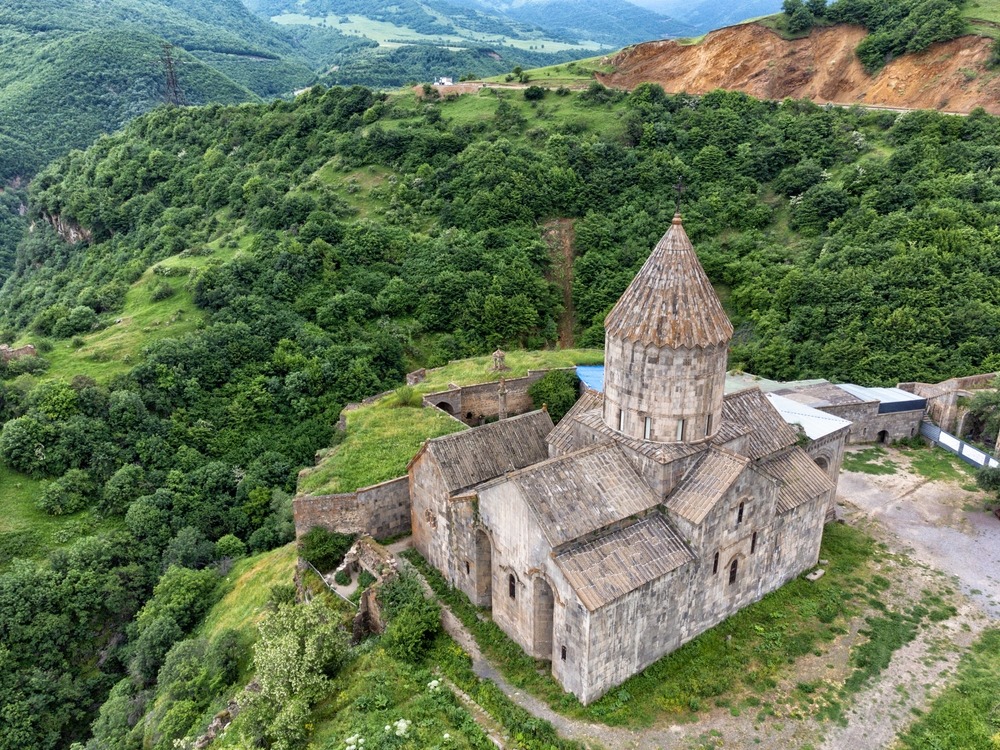
Khndzoresk fits well into a tour of southern Arménie. In the immediate area, Goris and its own rock formations merit a stop. The Tatev monastery, accessible by the "Wings of Tatev" cable car, is about an hour's drive away. Further north, on the return route to Yerevan, you can plan a stop at Areni, known for its wines and prehistoric cave.
Frequently asked questions
Allow 2 to 4 hours for a complete tour: descent into the gorge, crossing the suspension bridge, visiting the churches and Mkhitar Sparapet's tomb, then ascent. A quick visit from the viewpoint alone takes about 30 minutes.
At 160 metres long, it sways slightly when traversed. It remains safe and accessible to all, but may unsettle those very sensitive to heights. It is also the best spot to photograph the gorge.
Yes, it's actually the most classic combination from Goris. Plan a full day: Tatev in the morning via cable car, lunch in Goris, then Khndzoresk in the late afternoon to enjoy the light on the gorge.
The viewpoint café, open from May to October, offers drinks and light refreshments. For a full meal or overnight stay, it's better to base yourself in Goris, which concentrates guesthouses and restaurants.
Preparing your trip
Khndzoresk naturally fits into an itinerary covering southern Arménie, between religious heritage, gorge landscapes and traditional villages. To build a bespoke trip combining Goris, Tatev and the Vorotan valley, consult our suggestions for travel to Arménie.
Interested in this visit?
We can include it in your personalised itinerary.