Armenian Alphabet Monument
Armenian Alphabet Monument
At the foot of Mount Aragats, 39 stone letters pay homage to Mesrop Mashtots, creator of the Armenian alphabet in 405. A free-access site just 1 hour from Yerevan.
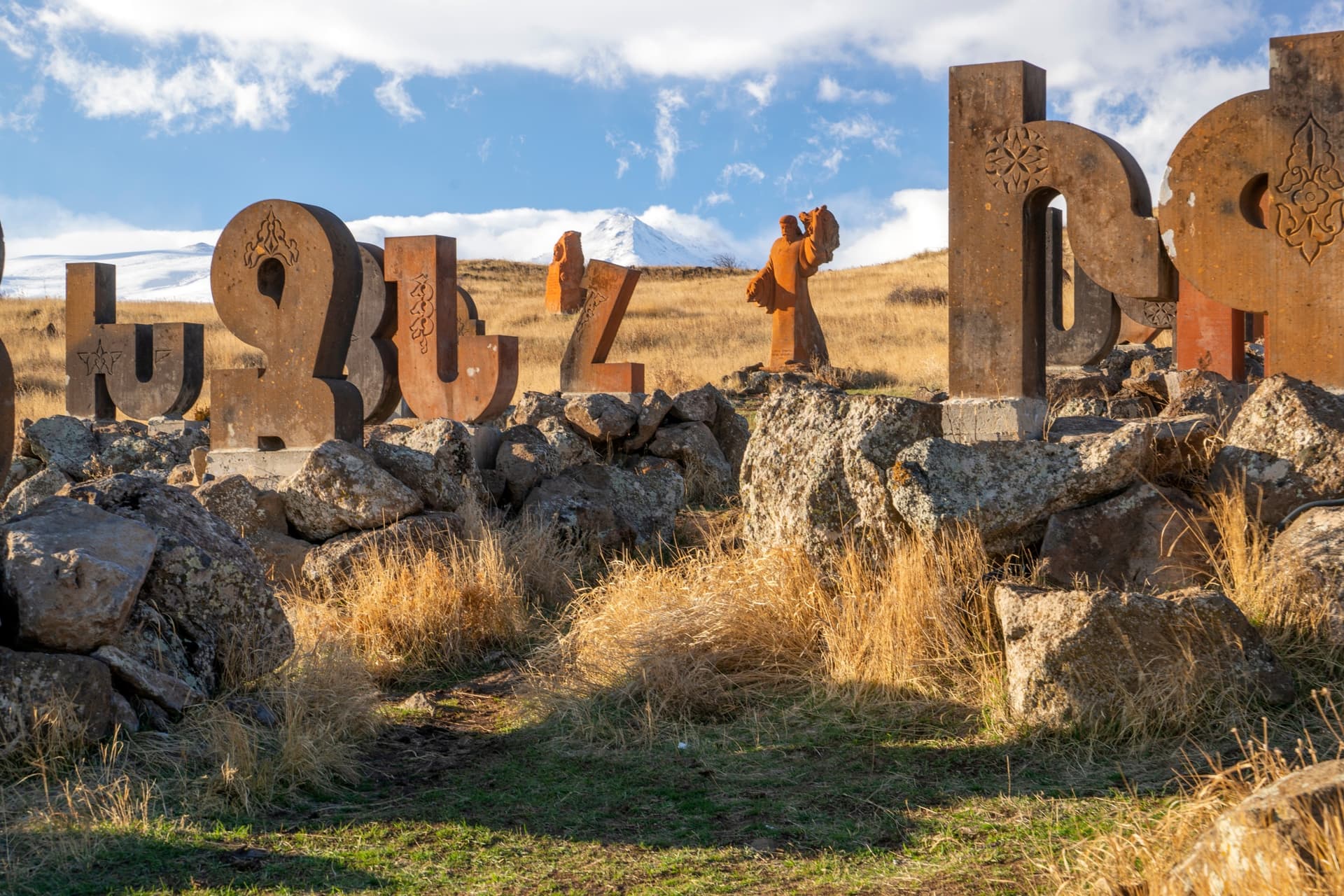
On the slopes of Mount Aragats, an hour's drive from Yerevan, 39 stone letters carved into volcanic tuff form a semicircle in the middle of a field. This monument, inaugurated in 2005, pays homage to Mesrop Mashtots, creator of the Armenian alphabet in 405, and to a writing system still in use sixteen centuries later.
Why visit the Armenian Alphabet Monument
Few countries have a monument dedicated to their own letters. For Armenians, the alphabet created by Mesrop Mashtots represents an identity pillar as vital as language or faith itself. The site makes for a pleasant stop of around an hour on the road connecting Yerevan to Mount Aragats or Ashtarak. You'll encounter few tourists here, many Armenians photographing the initial letter of their name, and an unobstructed panorama of the country's highest peak.
History of Armenian Writing
The Armenian alphabet appeared in 405, under specific circumstances: the kingdom's recent conversion to Christianity and the need to translate the Bible into a language that previously lacked its own script. Before this date, Armenians used Greek, Persian, or Syriac alphabets, all poorly suited to the sounds of their language.
Mesrop Mashtots, a learned monk, led the project with the support of his disciple Isaac of Armenia and the backing of King Vramshapuh. The alphabet initially contained 36 letters, borrowing certain features from Greek and Syriac syllabaries. Three additional letters were added in the 12th century, bringing the total to 39.
A detail often noted: the first two letters, A and B, form the word ab ("father"), and the last two, K and H, form keh ("life"). A symbolic coherence between the first and last letters that is likely no accident from a monk translating Scripture.
What you'll see on site
The monument unfolds in a semicircle across an open esplanade. The 39 sculptures stand approximately 1.5 meters tall, each weighing roughly as many tons, carved from local volcanic tuff—a stone that shifts from red to pink, yellow, and gray depending on the block. Each letter bears engraved motifs: geometric, floral, or animal designs inspired by Armenian ornamental tradition.
At the center, a five-meter bronze statue represents Mesrop Mashtots and his pupils holding a scroll inscribed with the opening words of the Bible in Armenian. The circular base is surrounded by four columns symbolizing the four Evangelists.
The entire ensemble was designed by architect Jim Torosyan and inaugurated on October 16, 2005, in the presence of the Republic's president and the Catholicos of Armenia, on the occasion of the alphabet's 1600th anniversary.
Practical information
The site requires no entrance fee or specific opening hours: it's an open-air location with free access. Plan 30 minutes to 1 hour on site, depending on your interest in ornamental details and photography. A few basic guidelines:
- Do not climb on or lean against the sculptures.
- Leave no litter; the site is not permanently staffed.
- Bring water and snacks: there are no shops nearby.
When to visit
Spring (March to May) and autumn (September to November) offer the most pleasant conditions, with moderate temperatures and favorable light for photography. Summer is dry and hot on the Aragats plateau, manageable but with little shade—a hat is recommended. Winter transforms the site: snow blankets the letters and creates interesting visual contrast, but the road may become impassable after heavy snowfall.
How to get there
The monument sits along the road, roughly twenty kilometers northeast of Byurakan and about 15 km from Ashtarak. From Yerevan, expect approximately one hour's travel via the M3 and then the H3.
By car is the simplest option, and the site combines easily with a full day exploring Aragats or the Byurakan Observatory. Without a vehicle, you can negotiate a day-rate taxi from Yerevan, or take a minibus (marshrutka) heading toward Ashtarak and continue by local taxi. Agree on price and wait time before departing.
Nearby attractions
Mount Aragats dominates the landscape: at 4,090 meters, it's the country's highest point, and several cultural interpretations link it to the origins of Armenian civilization. Four summits surround a crater, accessible at varying levels of difficulty.
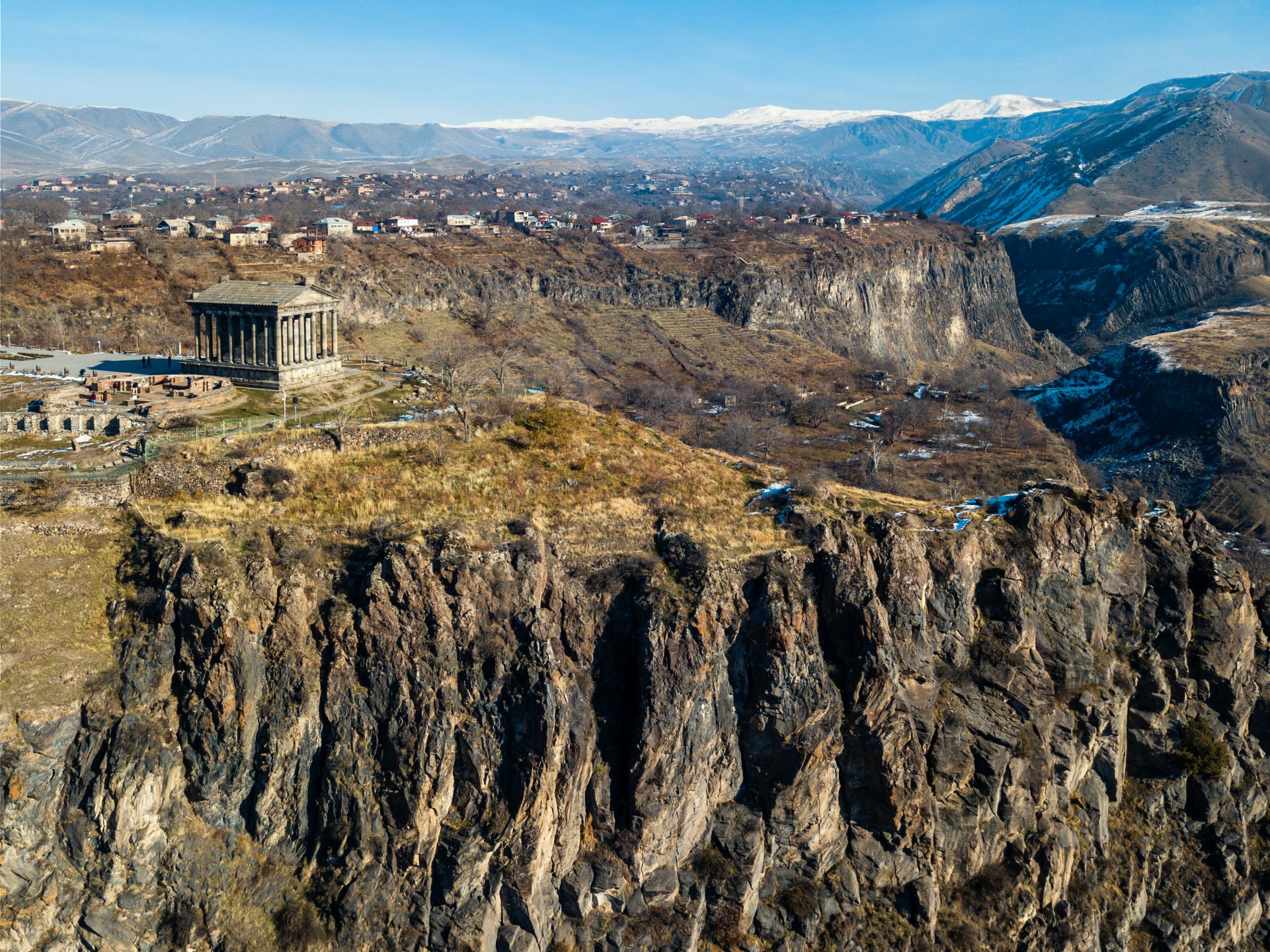
About an hour's drive away, the Temple of Garni, a pagan structure from the 1st century BCE, remains one of the rare pre-Christian testimonies in the region. Further south, the Noravank Monastery and, for those extending back toward Yerevan, the Armenian Genocide Memorial round out a historical reading of the country. The Khor Virap Monastery, roughly an hour's drive away, offers a close view of Mount Ararat.
Frequently asked questions
Frequently asked questions
Mesrop Mashtots, a learned monk, in 405. He worked with his disciple Isaac of Armenia and received support from King Vramshapuh. The initial goal was to translate the Bible into a language of its own.
The original alphabet contained 36 letters. Three additional letters were added in the 12th century to transcribe sounds absent from the initial system, bringing the total to 39.
Between 30 minutes and 1 hour is sufficient to tour the 39 sculptures and the central statue. The site combines well with a broader excursion toward Aragats or Ashtarak.
A day-rate taxi remains the most practical solution. Otherwise, take a minibus toward Ashtarak and then a local taxi to the site, agreeing on price and wait time in advance.
No, the esplanade is outdoors and access is free, with no set opening hours.
To integrate this stop into a broader itinerary, consult our trips to Armenia.
Interested in this visit?
We can include it in your personalised itinerary.