Selim Caravanserai
Selim Caravanserai
A 14th-century medieval relay set at 2,410 m on the Selim Pass, between Yeghegnadzor and Lake Sevan, bearing witness to Armenian-Persian trade routes.
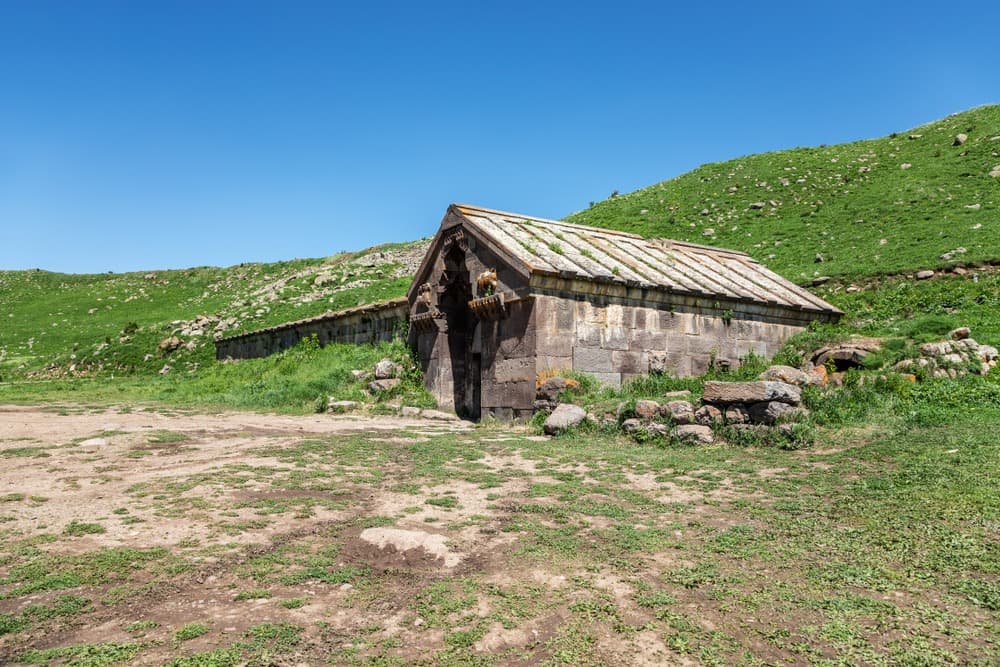
Perched at 2,410 metres altitude on the Selim Pass in the Vardenis Mountains, the Selim Caravanserai stands as one of Armenia's best-preserved medieval relays. Built in the 14th century, it marked a waystation on the trade route connecting the Arab-Persian world to the Caucasus regions, midway between Yeghegnadzor and Lake Sevan.
Why visit the Selim Caravanserai
Three reasons make this isolated site worth a stop:
- A rare medieval civil structure in Armenia, its original framework wholly intact.
- Hybrid architecture blending Armenian and Islamic influences, evident from the portal itself.
- A high-altitude setting commanding sweeping views over the valleys of Vayots Dzor and Gegharkunik.
Unlike the churches and monasteries that dominate Armenian heritage, the Selim Caravanserai documents the country's mercantile dimension in the Middle Ages.
History
The Selim Caravanserai, also known as Soulèma, dates back to the 14th century. It lay on a major trade route linking the Arab-Persian world to the Caucasus regions, and for centuries welcomed travellers and caravans laden with silk, spices and metals.
Its isolated, high-altitude location afforded it some protection from later destruction. The building underwent two restorations in the 1950s and 1960s, stabilising the structure and preserving the essence of the medieval work. Armenian and Persian inscriptions visible on its walls recall its function and role in regional exchanges, as well as the identity of its princely patron.
What to see on site
The entrance and its decoration
The sole entrance, designed for better protection, takes the form of a Muslim-inspired airlock topped by a niche adorned with stalactite work. On either side of the portal, two sculptures stand guard: a chimera to the left and an ox to the right, symbolic motifs of travel and protection.
The main hall
Built of basalt, the edifice marries Armenian and Islamic styles. The main hall, oriented west to east, comprises three naves separated by eight pairs of square pillars linked by arches. The side naves accommodated travellers, while the central nave served the animals. The barrel vaults rest on arch-doubleaux, and three ornamental skylights with stalactite work provide light and ventilation. The low-pitched gabled roof protects the whole against the elements.
The khachkars
Near the building, several khachkars—finely carved stone stelae bearing a cross surrounded by vegetal motifs—complement the ensemble and bear witness to Armenian stone-carving tradition.
Practical information
- Visit duration: allow 30 to 45 minutes on site, not including travel time.
- Access: the site is freely accessible, with no permanent ticketing. A modest contribution may be requested depending on the season.
- Equipment: bring a windproof jacket, even in summer. The pass is exposed and temperatures drop sharply with altitude.
- Services: no shops or dining facilities on site. Fill up with fuel and water in Yeghegnadzor before heading up.
When to go
The favourable season runs from late May to mid-October. The Selim Pass reaches 2,410 metres and the road is regularly closed in winter and spring due to snow and ice. Check road conditions before departing between November and April.
June and September offer the best conditions: mild temperatures, often clear skies and optimal visibility over surrounding massifs. In peak summer, set out early in the morning to avoid the altitude storms that typically form in early afternoon.
How to get there
The caravanserai lies some thirty kilometres north of Yeghegnadzor, along the M10 road connecting this town to Martouni, south of Lake Sevan. The site marks the boundary of the former cantons of Vayots Dzor and Gegharkunik.
- From Yerevan: allow about 2.5 to 3 hours by road via the M2 motorway then the M10 (≈ 120 km).
- From Lake Sevan (Martouni): 1 to 1.5 hours on the M10, in continuous ascent.
- Vehicle: the road is asphalt but winding, with many tight bends. A vehicle in good condition suffices in season; a 4x4 is recommended outside the summer period.
What to see in the region
The caravanserai sits naturally within an itinerary combining heritage and mountain landscape:
- Noravank Monastery, the jewel of Vayots Dzor, accessible from Yeghegnadzor via a spectacular gorge.
- Selim Monastery and Areni Cave, celebrated for its archaeological remains.
- The Temple of Garni, the sole Greco-Roman structure preserved in the Caucasus, on the return route to Yerevan.
- The Armenian Genocide Memorial in Yerevan, a major historical stop to understand the country.
Continue your journey
The Selim Caravanserai fits naturally into a circuit connecting Yerevan to Lake Sevan via Vayots Dzor. To plan your full itinerary, consult our trips in Armenia and tailor your route according to season and interests.
Interested in this visit?
We can include it in your personalised itinerary.