Amberd Fortress
Amberd Fortress
At 2,300 m on the slopes of Mount Aragats, Amberd Fortress combines medieval Pahlavouni remains, an 11th-century church, and panoramic alpine views.
Perched at 2,300 meters elevation on the southwest foothills of Mount Aragats, Amberd Fortress overlooks the confluence of the Arkachen and Amberd gorges. Its Armenian name means "fortress in the clouds," an apt description for a site regularly shrouded in mist. About 50 km from Yerevan, in the Aragatsotn region, the complex brings together military remains, a medieval church, and high-mountain panoramas.
Why visit Amberd Fortress
Amberd ranks among the rare Armenian medieval fortresses still legible in the landscape. The site offers three distinct appeals: well-preserved defensive architecture in volcanic stone, an 11th-century church adjoining the ramparts, and a natural setting above 2,000 meters facing Mount Aragats. The visit works equally well as a historical stop or an altitude excursion from the capital.
Site history
The promontory has been fortified since the 7th century, during the era when the Kamsarakan princes controlled the region. In the 10th-11th centuries, the fortress passed to the Pahlavouni, who enlarged the enclosure, added towers, and reinforced defenses. Under this dynasty, the church known as Vahramashen was erected in 1026, named after its patron, Prince Vahram Vatchoutian (sometimes spelled Vahram Pahlavouni).
During the 13th century, Mongol raids struck the stronghold hard. Damaged repeatedly, it was restored then gradually abandoned in the late Middle Ages. Excavations conducted in the 20th century uncovered the structures visible today, along with archaeological artifacts now displayed in the site museum.
What to see on-site
The fortress
The enclosure, built in dark volcanic stone typical of the Mount Aragats region, follows the contours of the rocky spur. Inside, you can distinguish the remains of a public bath fed by ceramic piping systems, stables, storage facilities, and several workshops. These arrangements testify to organized residential and economic life beyond mere military function.
Vahramashen Church
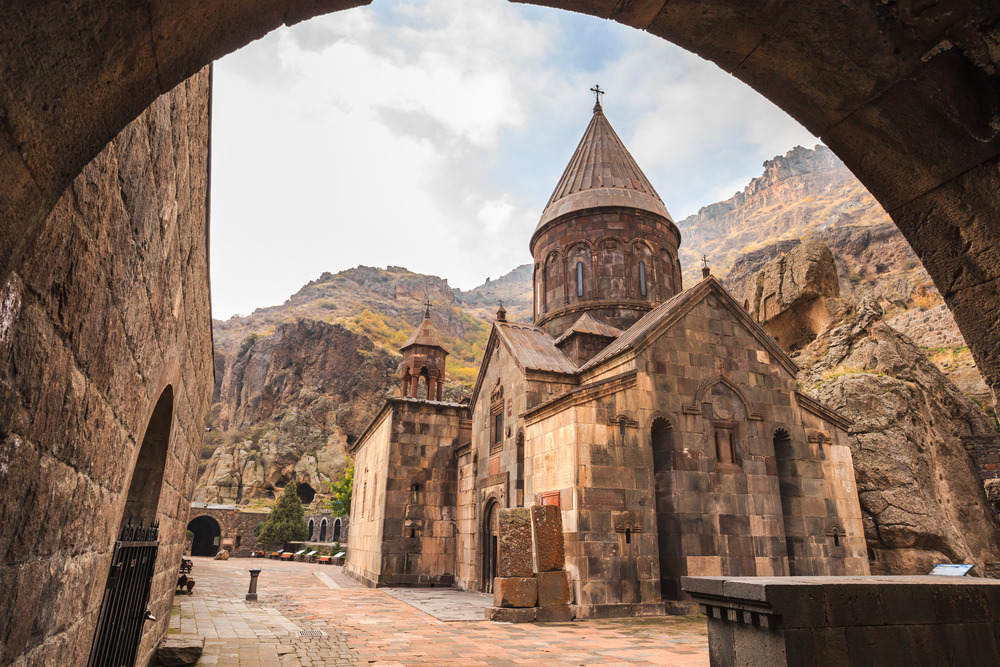
Built in 1026, the church features an inscribed cross plan and an octagonal drum topped by a conical roof, characteristic of 11th-century Armenian architecture. It remains an active place of worship during services. A marked trail leads directly from the parking area to the building without crossing the fortress, convenient for a brief visit.
The museum
The small museum on-site displays pottery, weapons, jewelry, and coins from archaeological excavations. The pieces span several centuries of occupation and help contextualize the ruins visible outside.
Practical information
Plan 1.5 to 2.5 hours on-site to explore the fortress, church, and museum at a leisurely pace. The terrain is uneven: wear hiking boots, bring water, pack a windbreaker even in summer (wind regularly blows at this altitude), and use sun protection. A site map, available at the entrance, helps identify different buildings.
The site is freely accessible for much of the year. The museum follows seasonal hours and charges a modest fee.
When to visit
The best period extends from late May through early October. In July-August, temperatures can reach 40°C in the Yerevan plain, but the altitude keeps conditions milder at Amberd. In winter, the access road is regularly closed by snow and temperatures can drop to -20°C. May-June and September typically offer the best balance between accessibility and light.
How to get there
Amberd lies about 50 km northwest of Yerevan, roughly 1.5 hours' drive. The route passes through Ashtarak then follows a winding mountain road to the parking area at the base of the site. A personal car or day-long taxi are the most convenient options; no direct public transport exists. Several agencies offer guided excursions combining Amberd with other sites in the region.
What to combine nearby
- Lake Kari: glacial lake at 3,200 m elevation, accessible via the same road roughly 30 minutes higher. A mineral setting ideal for hiking during the summer season.
- Karmravor Monastery in Ashtarak, about 25-30 km downhill: a 7th-century church with a conical dome, one of Armenia's smallest and best-preserved.
- Armenian Alphabet Monument: near the road between Yerevan and Amberd, on the slopes of Mount Aragats.
- Garni Temple and Goshavank Monastery, to extend the heritage itinerary around Yerevan.
Frequently asked questions
Frequently asked questions
Plan 1.5 to 2.5 hours on-site for the fortress, Vahramashen Church, and museum. Including the round trip from Yerevan, budget a half-day to a full day.
Access becomes difficult from December to March: the mountain road is regularly snowbound and may be closed. It's better to plan your visit between May and October.
No direct bus runs from Yerevan. A personal car, day-long taxi, or guided excursion remain the simplest solutions.
The fortress is a defensive complex of the Pahlavouni (10th-11th century), partly ruined. Vahramashen Church, built in 1026, is adjacent but accessible via a dedicated trail from the parking area, without crossing the ruins.
To include Amberd in a complete itinerary, consult our Armenia travel programs.
Interested in this visit?
We can include it in your personalised itinerary.