Noravank
Noravank
Noravank, a 13th-century monastery nestled in the Arpa Gorges, blends medieval architecture with dramatic red-cliff landscapes. An active religious site and one of Armenia's finest medieval sculptural ensembles.
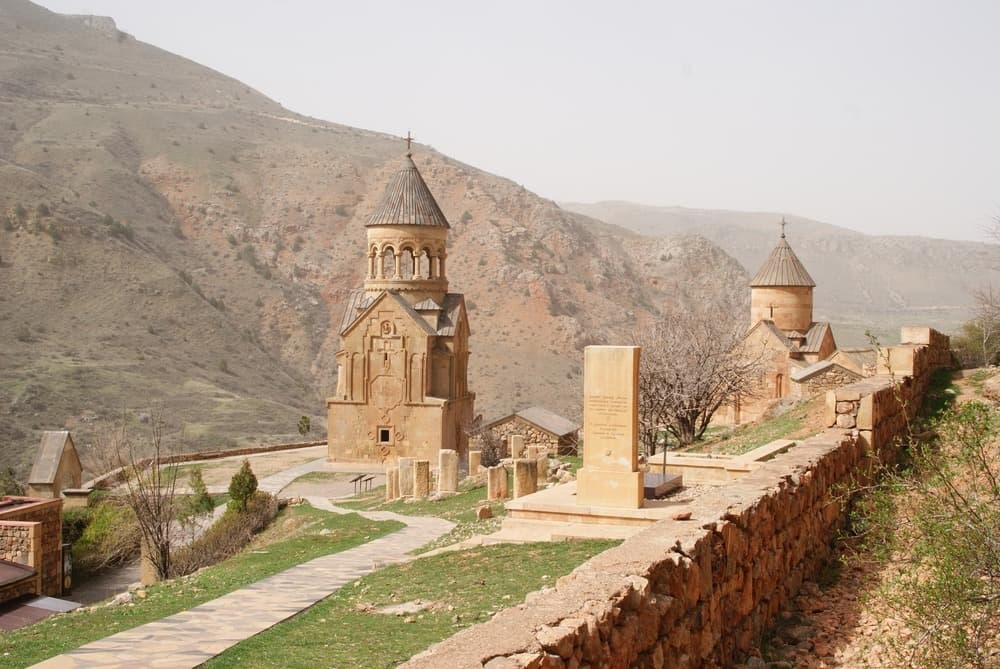
Noravank is a 13th-century Armenian monastery set deep within the Arpa Gorges in Vayots Dzor province. Its two churches of red tufa rise against nearly vertical ochre cliffs, creating an architectural and natural tableau rarely matched in Armenia. The site remains religiously active and stands as one of the country's best-preserved medieval complexes.
Quick Facts
- Entrance: free (donations welcome)
- Dress code: shoulders and knees must be covered; scarves available at the entrance
- Recommended duration: 1 to 1.5 hours on site
- Access: paved road from the town of Yeghegnadzor; no regular public transport — car or taxi recommended
- Accessibility: sloped terrain and steep stairs; limited access for persons with reduced mobility
What to See
The complex comprises two main churches. Surb Karapet (Saint John the Baptist, 13th century) is the oldest; its façade bears finely carved bas-reliefs. Surb Astvatsatsin (Holy Mother of God, 1339) stands out for its external double-flight staircase leading directly to the portal on the first floor — a unique medieval engineering feat in Armenia. The khachkars (carved stone crosses) scattered throughout the compound showcase the skill of local stonemasons.
History and Context
Noravank literally means "new monastery" in Armenian. Founded in the early 13th century, it quickly became the pantheon of the Orbelian princes who ruled the region. The sculptor and architect Momik, a major figure in medieval Armenian art, worked here in the late 13th and early 14th centuries. He notably signed the bas-reliefs of Surb Astvatsatsin and several remarkable khachkars. The site suffered earthquakes but underwent multiple restorations over the centuries.
Visit Highlights
The Suspended Staircase of Surb Astvatsatsin
The external double-flight staircase, without original railings, climbs steeply toward the sculpted portal on the first floor. The ascent demands sure-footedness, but the view over the cliffs from the threshold is breathtaking. Study the reliefs on the tympanum: a Christ in majesty flanked by angels, attributed to Momik.
Momik's Khachkars
Several 14th-century carved stone crosses are attributed to Momik. Their exceptionally fine vegetative interlace illustrates the apex of this distinctly Armenian art form. Take time to explore the compound to find them.
The Arpa Gorges
The approach road traces red and pink tufa cliffs for several kilometres. Stop at natural viewpoints before reaching the monastery: late afternoon light tints the cliff faces in an especially intense coppery hue.
Etiquette and Visiting Rules
- Cover shoulders and knees before entering the churches.
- Speak quietly inside the chapels; services may be taking place.
- Do not touch khachkars or sculptures.
- Place votive candles in designated spaces, not on stone surfaces.
Photography Tips
Late afternoon light (4–6 p.m. in summer) makes the cliffs behind the churches glow red — this is the most photographed moment. In the morning, light is softer and the site less crowded. A path ascending to the left after the entrance offers a slightly elevated angle that frames both churches against the cliff backdrop. Photography is permitted outdoors; inside the chapels, check with the caretaker.
Location and Access
Noravank lies about 9 km south of Yeghegnadzor, capital of Vayots Dzor province, along a road that descends into the Arpa Gorges. From Yerevan, allow roughly 2 hours of driving (M2 highway then regional road). No regular buses serve the site; a taxi from Yeghegnadzor or a rental car are the most practical options. Local agencies in the Nomadays network offer excursions combining Noravank with other regional sites.
Nearby Sites
- Tatev Monastery — a major medieval complex accessible by the Wings of Tatev aerial tramway, about 60 km to the southeast.
- Areni Cave — a prehistoric site where the world's oldest leather shoe was discovered, a few kilometres to the north.
- Areni Village — renowned for its red wines; several cellars offer tastings.
- Yeghegnadzor — a waypoint town with a local market and a base for exploring the province.
Frequently asked questions
Spring (April–June) and autumn (September–October) offer pleasant temperatures and vegetation that contrasts beautifully with the red cliffs. In summer, heat in the gorges can be intense midday; prioritize an early morning or late afternoon visit.
Yes. Shoulders and knees must be covered to enter the churches. Scarves and shawls are typically available at the site entrance if you don't have your own.
Yes, it's feasible. A classic itinerary links Yerevan, Areni village (wine tasting), Noravank, and back. With a car, plan a full unhurried day.
It is steep and narrow, without railings over its full height. Those prone to vertigo or with reduced mobility may prefer to admire it from below. In wet conditions, the tufa steps can be slippery.
Photography is freely permitted outdoors. Inside the chapels, it is courteous to ask permission from the caretaker or priest present, out of respect for the active place of worship.
A small refreshment area and a few souvenir stands are typically present at the entrance, though offerings remain limited. Bring water and a snack if visiting outside peak season.
Want to discover this destination?
Our local advisors design your tailor-made trip.