Sevanavank Monastery
Sevanavank Monastery
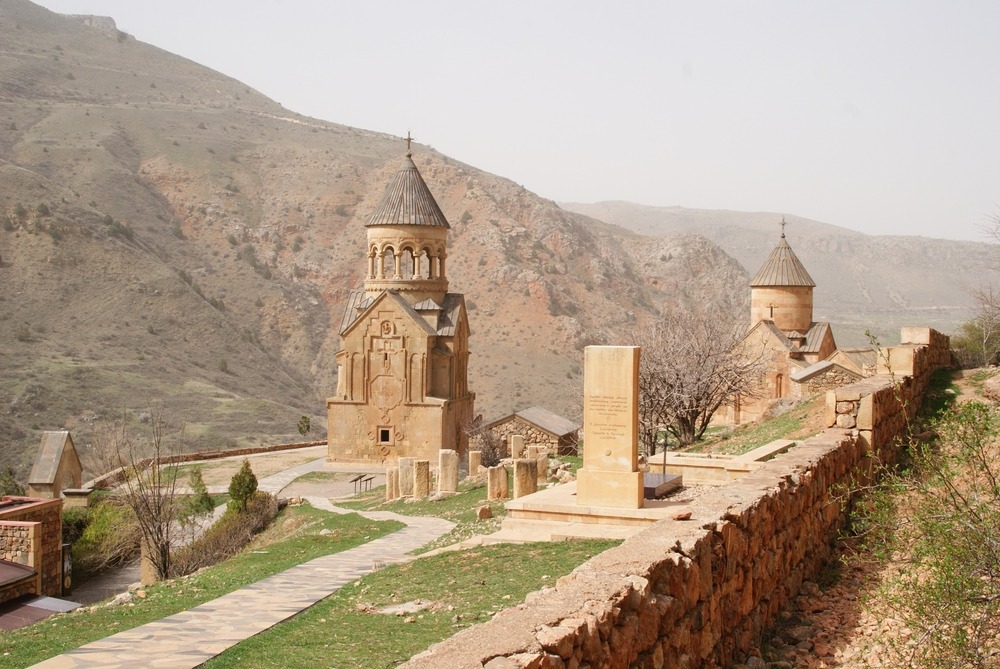
Perched on a peninsula of Lake Sevan at 2,000 meters altitude, Sevanavank Monastery, founded in 874, preserves two medieval churches emblematic of Armenian architecture.
Sevanavank Monastery stands on a peninsula of Lake Sevan, at 2,000 meters altitude, in the marz of Gegharkunik. Founded in the 9th century, this Armenian monastic site brings together two surviving medieval churches and offers, from its hilltop, an unobstructed view of one of the Caucasus's largest high-altitude lakes.
Why visit Sevanavank
Sevanavank concentrates several points of interest in one place: an architectural ensemble illustrating the evolution of Armenian religious art (the transition from free cross to inscribed cross), a spectacular location on a peninsula that was once an island—nicknamed the "island of birds"—which became accessible on foot after the lake level dropped during the Soviet era, and immediate proximity to Yerevan making it one of the most accessible excursions from the capital.
The site lends itself to a short visit, complemented by a stroll along the lake shore or a meal of local fish (ichkhan trout, local cuisine).
History of the monastery
The present monastery was founded in 874 by Princess Mariam, daughter of Ashot Bagratuni and wife of Prince Vasak V. Tradition recounts that a vision indicated to the future Catholicos Mashdots the exact location where the sanctuary should be built. The site was erected on the former island of birds, in the southwestern part of the relief.
Over the centuries, Sevanavank experienced several cycles of destruction and reconstruction. Damaged during Arab invasions, it underwent significant restoration in the 17th and 18th centuries. The monastery became a center for miniature production, where monks lived under austere rules, including the prohibition of wine and meat consumption.
In the 19th century, the complex extended far beyond the churches: it encompassed villages, mills, farms and gardens, forming a veritable agricultural community. In the 20th century, much of this ensemble was dismantled. Only the two churches remain, restored in the 1950s.
What to see on site
The site consists mainly of two churches, complemented by the remains of a gavit and other structures. The ensemble illustrates the evolution of Armenian architecture, particularly the transition from free cross to inscribed cross.
Sourp Arakelots (Holy Apostles)
The smaller of the two churches features a triconchal dome, complemented by a chapel to the southeast and a porch to the southwest, without ornamentation. Its three semicircular apses open to the north, east and south. The central square is crowned by an octagonal drum pierced by four windows, topped with a conical roof whose slope was accentuated during renovations in the 17th and 18th centuries. The upper portions of the building are more carefully finished than the lower portions, and certain traces of restoration remain visible.
Sourp Astvatsatsin (Holy Mother of God)
Located southeast of Sourp Arakelots, this church was enlarged with additional spaces to the northeast and northwest, as well as a chapel to the southeast. Its drum, of irregular form, is compensated by a system of arches and pendentives. Khachkars (sculpted stone crosses) and narrow windows were added during 17th and 18th-century restorations.
The two carved walnut doors, one on the west, the other on the south, date respectively from before 1176 and from 1486. They represent the cross and Pentecost, and are today preserved in the Museum of History of Armenia in Yerevan. Inside, a khachkar from 1653 illustrates the descent into limbo, the crucifixion and Christ of theophanic visions.
Gavit and other remains
The square gavit adjoining Sourp Astvatsatsin was destroyed in the 1930s. Four wooden capitals from the 9th century remain, along with khachkars standing in the ruins, some of which are preserved in various museums. Nearby, the foundations reveal two chapels and the Church of Sourp Harutiun, already in ruins in the 19th century. A cross carved in 1448 by Grigor, from this latter church, is displayed in the Museum of History of Armenia.
Practical information
- Location: Sevan peninsula, 8 km from the city of Sevan, marz of Gegharkunik.
- Altitude: 2,000 m—bring a windbreaker even in summer, the hilltop is exposed.
- Site access: a staircase of approximately 200 steps connects the parking area to the churches. Allow 1 to 1.5 hours for your visit on site.
- Fee: free entry to the churches; parking at a modest rate.
- What to bring: clothing covering shoulders and knees to enter the sanctuaries, which remain active places of worship.
When to visit
At 2,000 meters altitude, the climate remains cool for much of the year. The months of May through September offer the most comfortable conditions, with mild temperatures and clear views of the lake. July and August are peak tourist season: the site can be crowded midday, so early morning or late afternoon visits are preferable.
Late spring (May–June) and early fall (September) remain the most pleasant windows, with favorable light for photography. In winter, the site is accessible but the staircase may be icy.
How to get there from Yerevan
Sevanavank lies approximately 60 km northeast of Yerevan, about 1 to 1.25 hours by road via the M-4 highway.
- By car: the simplest option. Exit marked "Sevanavank" before the city of Sevan, followed by a small road leading to the base of the hill.
- By marshrutka (minibus): regular departures from Yerevan's Northern Bus Station toward Sevan; a local taxi is then needed to reach the monastery (4 km).
- By organized tour: Sevanavank often features in circuits combining Lake Sevan, Dilijan and Haghartsin Monastery over one day.
Nearby
The Lake Sevan region and the road to Yerevan offer several natural extensions to your visit:
- The Hovannavank Monastery, another remarkable example of medieval Armenian religious architecture, on the return route to the capital.
- The Temple of Garni, the country's only preserved pagan sanctuary, to combine with Sevanavank over two days of excursion.
- In Yerevan, the Armenian Genocide Memorial and the Armenian Alphabet Monument complete the historical and cultural context.
Include Sevanavank in your journey
Sevanavank integrates naturally into an itinerary combining Yerevan, Lake Sevan and the forested region of Dilijan. To build a bespoke journey incorporating this site and the country's other monasteries, consult our travels in Armenia.
Nearby
Interested in this visit?
We can include it in your personalised itinerary.