Zvartnots Cathedral
Zvartnots Cathedral
Built in the 7th century on a plateau overlooking Mount Ararat, Zvartnots Cathedral stands as one of Armenia's most remarkable archaeological sites, inscribed on UNESCO's World Heritage list.
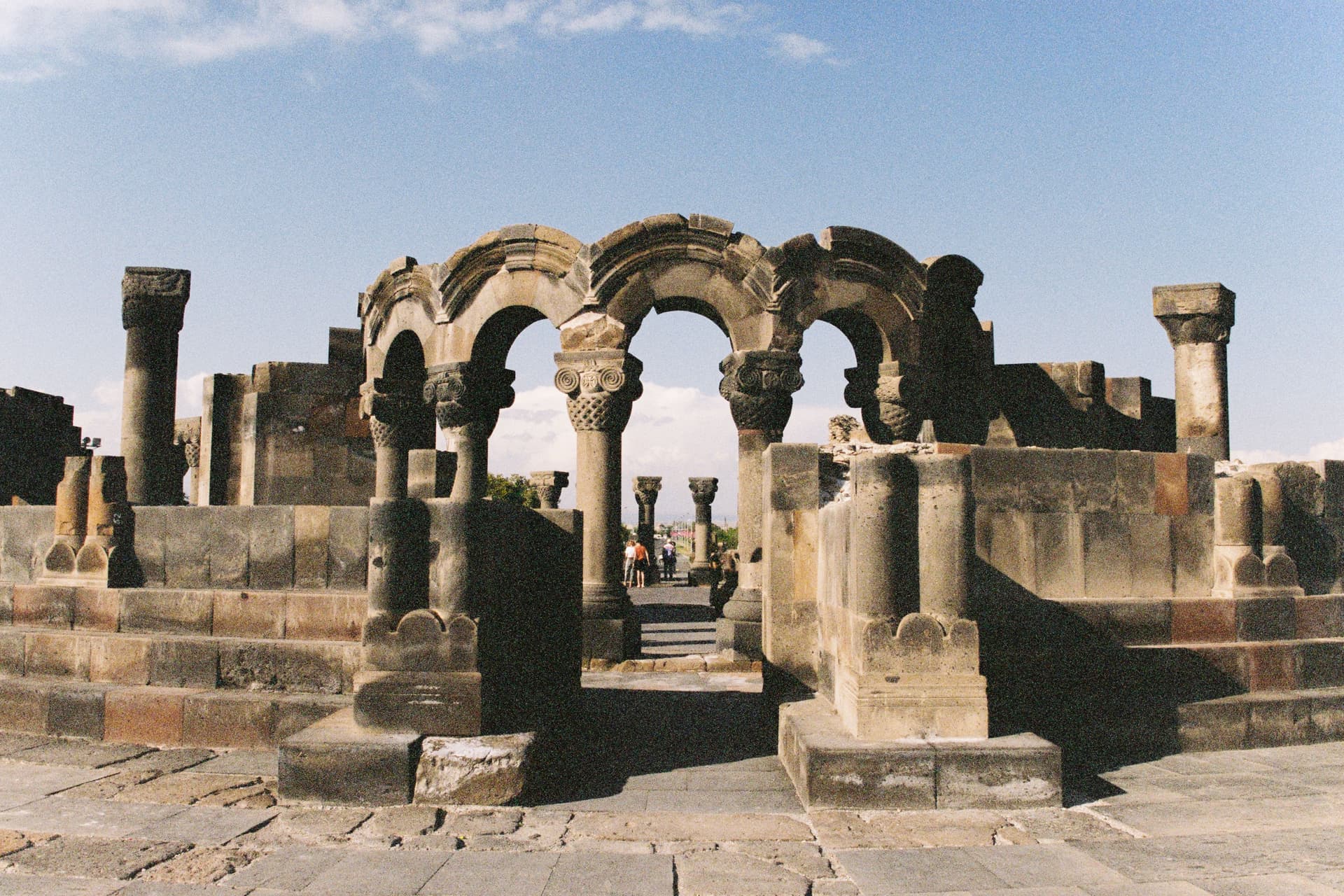
A few kilometers west of Etchmiadzin, the ruins of Zvartnots rise from an open plateau facing Mount Ararat. Constructed in the 7th century, this circular cathedral with three levels was among the most ambitious achievements of medieval Armenian architecture. Collapsed by an earthquake, it remains an exceptional testament to the engineering ingenuity of Christian Armenia, inscribed as a UNESCO World Heritage site since 2000.
Practical information at a glance
- Admission: paid entry (archaeological site and museum included)
- Recommended duration: 1 to 1.5 hours
- Access: by rental car or taxi from Etchmiadzin (approximately 5 km) or Yerevan (approximately 20 km); no reliable public transportation
- Dress code: no strict dress requirements (archaeological site, not an active place of worship)
- Accessibility: terrain partially accessible, main pathways navigable
What you'll see
The site features the foundations and partially reconstructed columns of the cathedral, whose trefoil plan with a central rotunda is unique for the period. An on-site museum houses ornately carved capitals, friezes adorned with pomegranate and vine motifs, and a scale model reconstructing the original building. The panoramic view of Mount Ararat on clear days is striking.
History and context
The cathedral was built between 641 and 661 by the Catholicos Nerses III, known as "the Builder." Its centralized plan with three apses and estimated height of over 45 meters made it an unparalleled structure in the Caucasus. An earthquake, likely in the 10th century, caused its collapse. Archaeological excavations began in the late 19th century; the ruins and adjoining museum were inscribed on the UNESCO list alongside Etchmiadzin.
Highlights of your visit
The columns and sculpted capitals
The pink basalt shafts still standing convey the scale of the vanished building. The basket capitals adorned with vegetative motifs and crosses represent some of the finest examples of Armenian sculpture from the early Middle Ages.
The on-site museum
Small but rich in content, it assembles the best-preserved stone elements: friezes, column bases, and inscription fragments. The sectional model allows you to visualize the original three-level elevation.
The view of Mount Ararat
The open plateau offers an unobstructed horizon toward the Greater and Lesser Ararat peaks. In late afternoon, raking light on the basalt stones and the snow-capped volcanic silhouette create a rare photographic setting.
Photography tips
Golden late-afternoon light (4 p.m.–6 p.m. in summer) enhances the rosy tone of the basalt. Position yourself southwest of the site to frame the columns with Ararat in the background. On overcast days, Mount Ararat vanishes from view: focus instead on sculpted details in soft, diffuse light. No known photography restrictions on the outdoor site.
Location and access
Zvartnots lies on the route connecting Yerevan to Etchmiadzin, approximately 20 km west of the Armenian capital. The most practical option is a rental car or taxi from Yerevan or Etchmiadzin. The site pairs naturally with a visit to the Etchmiadzin Cathedral, just a few kilometers away. No regular buses serve the site entrance directly.
Nearby attractions
- Etchmiadzin Cathedral — seat of the Armenian Catholicate, founded in the 4th century, inscribed by UNESCO.
- St. Hripsimé Church — a 7th-century Armenian architectural masterpiece in Etchmiadzin.
- St. Gayané Church — 7th-century basilical church within the same UNESCO complex.
- Etchmiadzin Treasury Museum — relics, illuminated manuscripts, and Armenian ecclesiastical metalwork.
Frequently asked questions
Spring (April–May) and autumn (September–October) offer pleasant temperatures and often clear skies, ideal for views of Mount Ararat. Summer is hot but the site remains accessible if visited early in the day.
Yes, both sites are just a few kilometers apart. Allow a full half-day to visit Zvartnots (1.5 hours) and the Etchmiadzin complex (1.5 to 2 hours) at a comfortable pace.
No. Zvartnots is an archaeological site, not an active place of worship. No dress code is enforced. Wear comfortable shoes for walking on uneven terrain.
Photography is allowed throughout the outdoor site. Inside the museum, check posted guidelines at the entrance, as some rooms may restrict photography of displayed artifacts.
The simplest option is a taxi or private driver from Yerevan. You can arrange a round-trip fare that includes a stop at Etchmiadzin. No direct bus service operates regularly to the site.
An earthquake, dated to approximately the 10th century, caused the building's collapse. Archaeological excavations beginning in the late 19th century uncovered the foundations and recovered many sculpted elements now displayed in the on-site museum.
Nearby
Interested in this visit?
We can include it in your personalised itinerary.