Garni Temple
Garni Temple
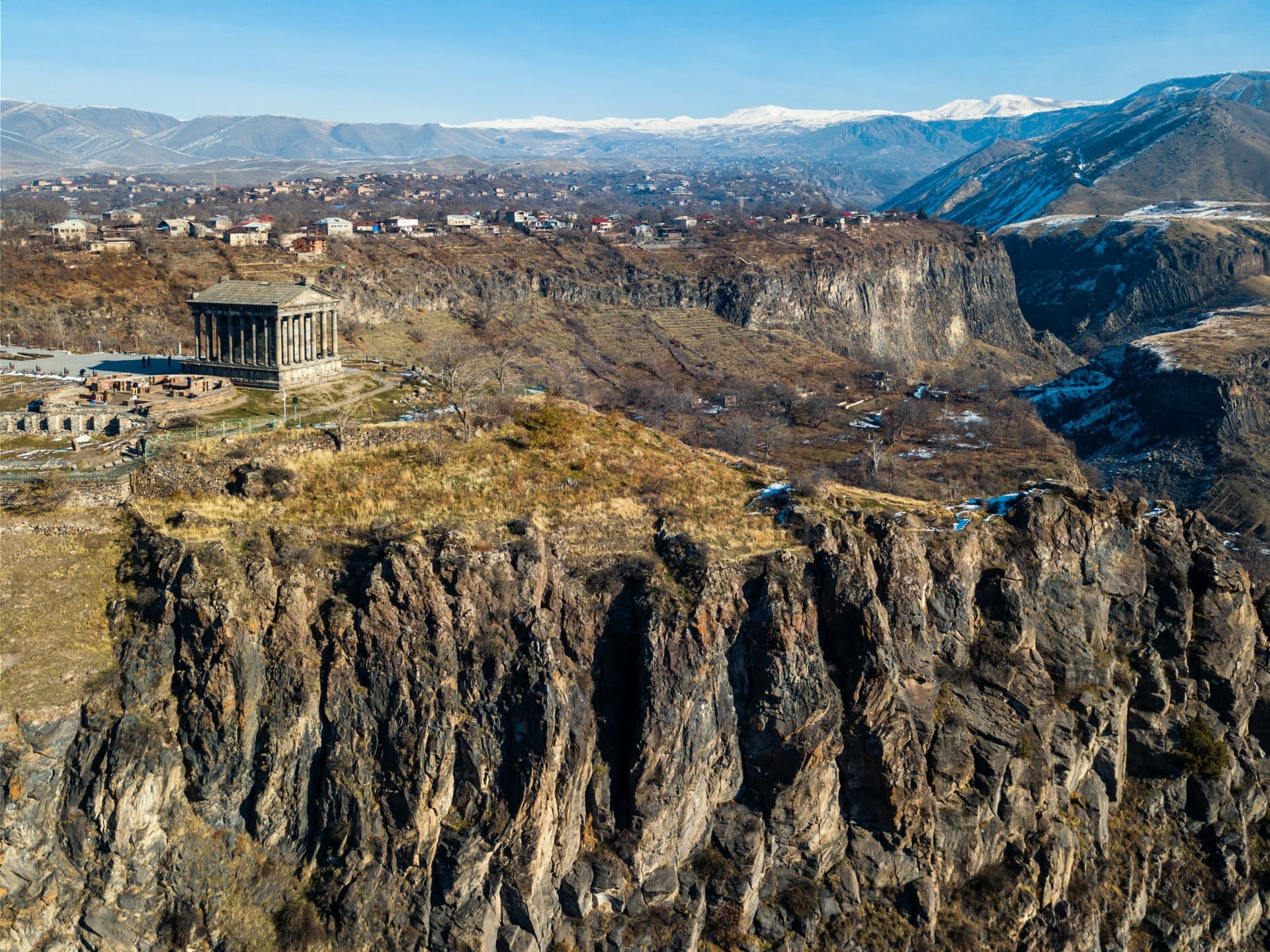
30 km from Yerevan, Garni Temple is Armenia's only pagan monument. A Greco-Roman sanctuary reconstructed in the 1970s, commanding views over the Azat Gorge.
Garni Temple stands on a basalt promontory overlooking the Azat Gorge, roughly 30 kilometers east of Yerevan. Armenia's sole surviving pagan monument, this Greco-Roman sanctuary has endured nearly two millennia, a devastating earthquake, and patient reconstruction to become one of the Caucasus's major archaeological sites.
Why visit Garni Temple
Garni holds a singular place in Armenia's cultural landscape. In a country that adopted Christianity as its state religion in 301 AD, this temple dedicated to the sun deity Mithra is the only pre-conversion building still standing today. Its Ionic silhouette, perched above a basalt canyon, layers several historical strata: a pagan sanctuary, Roman baths, a medieval church, and a contemporary memorial. Proximity to the Geghard Monastery, a UNESCO World Heritage Site since 2000, and the Stone Symphony in the Azat Gorge allows you to combine three complementary sites in half a day.
History: a pagan temple dedicated to Mithra
The building was commissioned by King Tiridates I in the 1st century as part of a royal complex comprising temple, baths, palace, and summer residence. It was consecrated to Mithra, a solar deity venerated in both the Orient and the Roman world. The famous Helios Stone, carved with a Greek inscription, attests to the royal commission and associates the sanctuary with Helios, the sun god.
When Armenia became the first Christian state in 301 AD, most pagan sanctuaries were dismantled. Garni escaped this fate, likely because it was repurposed as a royal summer residence. In 1679, a major earthquake reduced the temple to ruins. Blocks lay scattered across the site for nearly three centuries until archaeologists and craftsmen undertook reconstruction through anastylosis—reassembling original elements supplemented by stones quarried from the same local basalt—in the 1970s.
What to see on site
The temple itself
In Ionic style, the temple features a peristyle of 24 columns surrounding the cella, the inner chamber that once housed the altar. The triangular pediment is adorned with carved motifs, and the frieze showcases geometric and floral elements. The entire structure is built from basalt, a volcanic grey stone that gives the edifice its characteristic solidity and austerity.
The Roman baths
East of the temple, remains of 3rd-century baths comprise four rooms: vestibule, changing room, tepidarium, and caldarium. The hot room preserves a mosaic depicting figures and marine creatures, accompanied by a Greek inscription. Restored in 1978, it is now protected by a roof.
Saint Sion Church and the memorial
South of the temple, a small 7th-century church dedicated to Saint Sion survives in fragmentary condition with partially restored walls. To the west, a memorial inaugurated in 2015 for the centenary of the Armenian genocide honors the victims. The gardens contain several khachkars—carved stone crosses characteristic of Armenian art—dating from the 9th to 17th centuries, gathered from various regions across the country.
The village and lavash
The village of Garni, below the site, retains its rural character with stone houses, orchards, and vineyards. Several families offer demonstrations of lavash baking, the traditional Armenian flatbread prepared in a tonir, an underground oven where dough is pressed against scorching walls. Lavash is inscribed on UNESCO's intangible cultural heritage list.
Practical information
The site is open year-round, with extended hours during summer and reduced hours in winter. Entry is paid but remains moderate; a supplement applies for guided tours, available in Armenian, English, Russian, and French. Allow 1 to 2 hours to visit the temple, baths, and the gorge viewpoint.
- Wear sturdy shoes: the temple surroundings and path to the viewpoint feature irregular stone.
- Avoid flash photography and contact with sculptures and frescoes.
- The site is non-smoking and alcohol is prohibited.
When to visit
Spring (April–June) and autumn (September–October) offer the best conditions: mild temperatures, raking light that highlights the basalt and gorge vegetation. Summer is dry and hot, tolerable but not ideal for gorge hikes. In winter, the site remains open but may be snow-covered and temporarily closed after heavy falls. Weekday mornings see significantly fewer visitors than weekends and holidays.
How to get there
Garni lies approximately 30 km east of Yerevan. Several options exist:
- Taxi or ride-hailing: the quickest option, around 30 minutes. Agree on price beforehand and clarify whether the driver will wait for your return or take you on to Geghard.
- Marshrutka (minibus): the budget option from Gai bus station in Yerevan. The journey takes roughly 45 minutes to 1 hour. Verify route numbers and schedules on-site; they change regularly.
- Rental car: the M4 highway and turnoff to Garni are well-marked. Parking is available at the site entrance.
- Organized tour: most Yerevan agencies offer a half-day Garni–Geghard excursion, a convenient way to visit both sites in one trip.
Nearby attractions
Stone Symphony
At the bottom of the Azat Gorge, kilometers below the temple, hexagonal basalt columns form spectacular natural organ pipes. The site is reached on foot via a trail descending from the village or by 4x4 along the riverside track.
Geghard Monastery
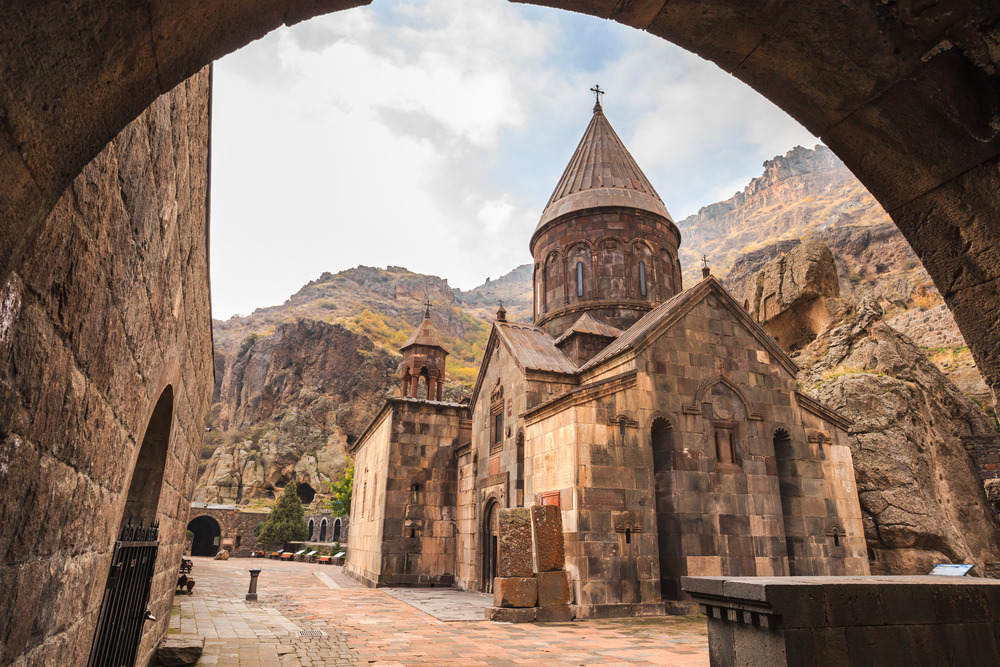
About ten kilometers away, this sanctuary partially carved into rock has been a UNESCO World Heritage Site since 2000. It traditionally houses the Holy Spear relic and makes a natural complement to a Garni visit.
Kakavaberd Fortress
Built in the 10th century atop a rocky spur commanding the Azat Gorge, this medieval fortress rewards a several-hour hike from the village of Avan. Walls and towers are largely preserved.
Aknalich Yazidi Temple
About fifty kilometers west, inaugurated in September 2019, this seven-domed sanctuary is one of the world's largest Yazidi places of worship and testifies to contemporary Armenia's religious diversity.
Frequently asked questions
Frequently asked questions
Extend your journey
Garni often makes up one of the first excursions from Yerevan, but Armenia abounds with complementary sites: the Sevanavank Monastery on Lake Sevan's shores, the Noravank Monastery in its red-sandstone canyon, or the Armenian Genocide Memorial in Yerevan. To craft a complete itinerary, consult our Armenia tours.
Nearby
Interested in this visit?
We can include it in your personalised itinerary.