Marmashen Monastery
Marmashen Monastery
Founded in the late 10th century in the Akhuryan gorges, Marmashen Monastery brings together three medieval Armenian churches 10 km from Gyumri.
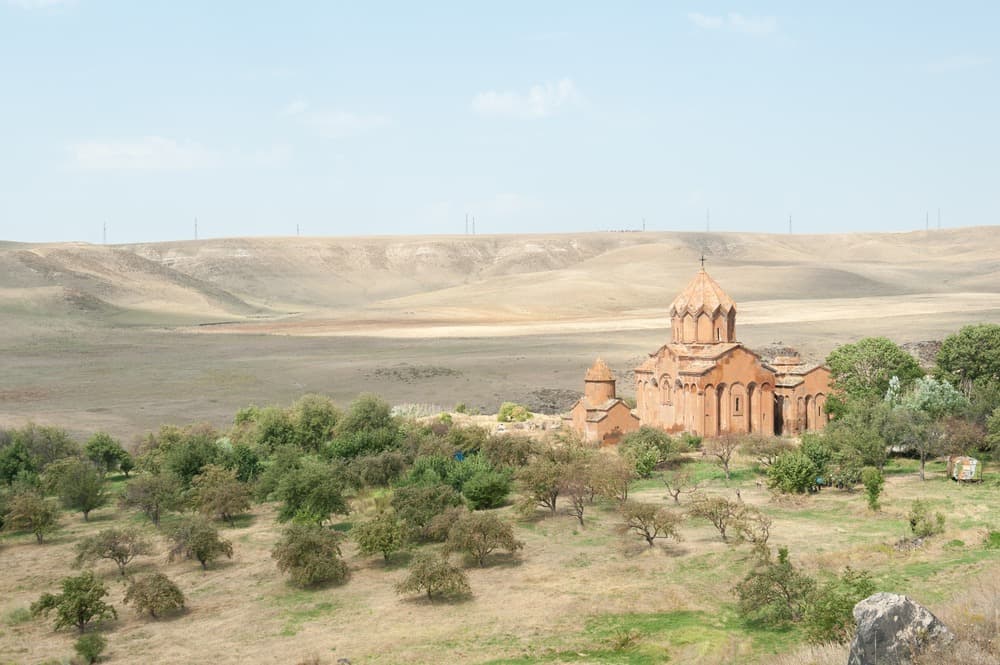
Marmashen Monastery stands as one of the rare Armenian monastic complexes from the 10th century to preserve its original layout. Located in the Shirak region, on the left bank of the Akhuryan River, it comprises three churches, with the main one, Katoghiké, reflecting the architectural pinnacle of the Bagratid kingdom.
Why visit Marmashen
Unlike many medieval Armenian monasteries built on isolated or defensive sites such as Tatev, Akhtala, or Arich, Marmashen sits nestled in a verdant valley floor, tucked into the heart of the Akhuryan gorges. The site remains relatively undiscovered and offers a peaceful encounter with medieval Armenian architecture, roughly thirty kilometers from Gyumri.
The chief appeal lies in how clearly the ensemble reads: the volumes of the Kathoghiké, the vestiges of Sourp Astvatsatsin, and the Sourp Petros church unfold across the same flat terrace, presenting a lucid picture of the monastery's evolution over centuries.
History of the monastery
In the late 10th century, Prince Vahram Pahlavouni, an influential figure in the Bagratid kingdom, founded the monastery and commissioned the construction of the main church, known as Katoghiké or Sourp Stepanos. Its construction spanned from 988 to 1029, a period during which Marmashen became one of the most significant religious centers in the Shirak region.
During the Seljuk invasions of the 11th century, the site suffered partial destruction and entered a period of decline. In the early 13th century, the monastery experienced a revival: around 1225, Gharib and Grégoire, grandsons of the founder, undertook the reconstruction of the main church and restored the site's religious and cultural significance.
Over the centuries, the complex preserved much of its original organization. The secondary buildings, more modest in scale, experienced the ravages of time unevenly. The 1988 earthquake, which devastated Spitak and the entire northwestern region of Armenia, weakened the remaining structures and necessitated consolidation work.
What to see on site
Katoghiké Church (Sourp Stepanos)
This is the central and best-preserved building of the monastery. Here you'll find the great principles of medieval Armenian architecture: a hall dominated by a dome resting on tall colonnades, half-colonnades set into the walls, and a polygonal exterior dome. The bas-reliefs and sculptural elements on the façades merit close examination, particularly the engraved crosses (khatchkars) and ornamental motifs.
Sourp Petros Church
Smaller in scale, it follows the same architectural principles as the Kathoghiké, in a simplified format. It complements the ensemble and illustrates how the domed church model was adapted for secondary buildings.
Sourp Astvatsatsin and vestiges
Sourp Astvatsatsin Church stands today in ruins. Its foundations and wall sections allow you to envision the monastery's scale at its height. Remains of ancillary buildings (refectory, dependencies) are also visible around the churches.
Practical information
- Access: open site, no fence or permanent ticketing office. Free admission.
- Fee: free entry.
- Visit duration: allow 1 to 1.5 hours to tour the three churches and observe the sculptural details.
- Equipment: closed-toe shoes recommended; the terrain is sloped and rocky in places.
- On-site: no services (no café or shop). Bring water.
How to get there
The monastery is located between the villages of Marmashen and Vagramaberd, approximately 10 km northwest of Gyumri, Armenia's second-largest city. From Gyumri, allow 20 to 30 minutes by car along the road that descends into the Akhuryan gorges.
From Yerevan, access is via Gyumri (approximately 120 km, 2 hours by road). Public transport to Marmashen village exists but is limited; the most practical option remains a taxi from Gyumri or a rental vehicle.
Best time to visit
The Shirak region experiences a continental climate marked by harsh winters with snow and below-freezing temperatures, and hot, dry summers. The most pleasant period extends from May to October, when the Akhuryan gorges become lush with vegetation. In winter, the road remains passable but the site, exposed to the elements, may be snow-covered.
Late afternoon hours offer favorable light on the rosy tuff façades of the Kathoghiké.
Nearby
The Shirak region and central Armenia offer several complementary sites:
- Gyumri: the historic center, its 19th-century architecture and museums merit a half-day visit.
- The Armenian Alphabet Monument, on the road between Gyumri and Yerevan, illustrates the importance of writing in Armenian culture.
- The Temple of Garni and Goshavank Monastery allow you to extend your discovery of the country's religious and ancient heritage.
- In Yerevan, the Armenian Genocide Memorial is an essential stop for understanding the country's contemporary history.
Plan your visit
Marmashen fits naturally into an itinerary combining Gyumri, northern Armenia, and Yerevan. To build a custom itinerary including the Shirak monasteries and other major sites across the country, explore our Armenia trips.
Interested in this visit?
We can include it in your personalised itinerary.