Syunik and Tatev
Armenia's southernmost province, Syunik lines up the Tatev Monastery perched above its gorge, the troglodytic village of Khndzoresk and the megaliths of Zorats Karer.
Syunik is Armenia's southernmost province, wedged between Azerbaijan to the east, Nakhchivan to the west and Iran to the south. From our agency in Yerevan, we count 4 to 5 hours of driving to reach Goris, the district capital that serves as a base for most itineraries. The M2 road, which descends from Vayots Dzor and crosses the Vorotan Pass at 2,344 meters, is also the sole terrestrial corridor connecting Armenia to Iran: you'll encounter as many Iranian trucks laden with dried fruits as 4x4s full of travelers.
The geography here is more rugged than elsewhere in the country. The Zangezur and Bargushat massifs exceed 3,900 meters, valleys plunge into deep gorges, and villages stretch across shelves at 1,400 or 1,700 meters altitude. The Vorotan, the province's main river, has carved a canyon over 700 meters deep that you cross by cable car to reach Tatev. Further south, around Kapan and Meghri, the climate warms noticeably, pomegranate and persimmon orchards appear, and you feel Iranian influence in the cuisine, notably in the widespread use of fragrant rice replacing bulgur.
Tatev Monastery, founded in the 9th century, was a major intellectual center of historic Armenia in the Middle Ages, with an active university from the 14th to 15th centuries. Its fortified complex, perched on a rocky spur above the gorge, still preserves its Church of Saints Paul and Peter (895-906) and its 13th-century gavit. The Wings of Tatev cable car, commissioned in 2010, covers 5,752 meters in 12 minutes from Halidzor: it's the simplest logistical option, but we also offer descent via the old trail that passes the Devil's Bridge and its sulfurous hot springs at 27°C.
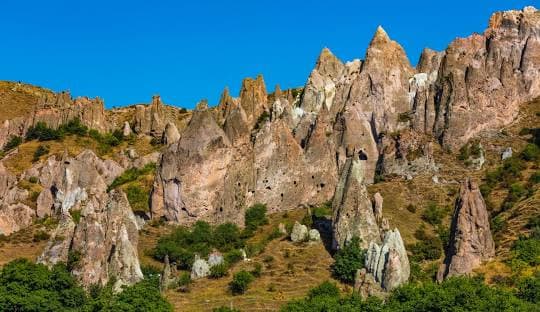
Goris, at 1,400 meters, is a small city of around 20,000 inhabitants known for its urban fabric of tuff stone and fairy chimneys visible from the eastern exit. From here you reach Khndzoresk, a troglodytic village carved into volcanic tuff, inhabited until the 1950s then abandoned when the Soviet government relocated the population to the new Khndzoresk below. A 160-meter suspension bridge, inaugurated in 2012, now crosses the ravine and provides access to the old dwellings and the 17th-century Church of Saint Hripsimé.
Further afield, the Zorats Karer site near Sissian lines up over 200 basalt megaliths standing on a plateau at 1,770 meters. Some are pierced with orifices that researchers interpret as astronomical sightings, dating the stones between 3,500 and 2,000 years before our era. An hour away, the Shaki waterfall drops 18 meters below the road, with flow regulated in summer for irrigation: we always call the caretaker the day before to confirm it's flowing on the day of the visit.
On the culinary side, Syunik stands out for zhingyalov hats, a flatbread filled with fifteen to twenty wild herbs that Goris women still prepare on the saj, and for cheeses aged in earthenware jars (motal) found at the Saturday market. The region remains largely rural, sheep herding dominates above 1,800 meters, and many families supplement their income with beekeeping and harvesting cornelian cherries from which a clear liquor is distilled.
To discover
Tatev cable car and monastery. Crossing the Vorotan gorge in 12 minutes above 320 meters of emptiness, then visiting the 9th-century monastic complex, which was one of medieval Armenia's greatest universities.
Khndzoresk troglodytic village. Descent into a tuff ravine carved with troglodytic dwellings abandoned in the 1950s, accessible from Goris via a 160-meter suspension bridge.
Zorats Karer megalithic alignment. Over 200 stones standing on a plateau at 1,770 meters near Sissian, dated between 3,500 and 2,000 years before our era, a dozen of which are pierced with orifices interpreted as astronomical.
Zhingyalov hats of Goris. Workshop at a local home making the flatbread filled with fifteen to twenty wild herbs picked in spring, cooked on the saj, an emblematic dish of southern Armenia and Artsakh.
Southern route to Meghri. Descent toward the Iranian border via the M2, pomegranate orchards at 600 meters altitude, architecture in baked brick and the Meghri bazaar where you encounter Iranian and Armenian traders.
When to visit
The most comfortable window for visiting Syunik stretches from mid-May to mid-October. In July and August, Goris stays around 28°C during the day and drops to 15°C at night thanks to its 1,400-meter altitude, but Meghri, at 600 meters in the Araxes valley, can exceed 38°C: we avoid scheduling hikes in the middle of the day there. May, June and September offer the best balance, with flowering meadows in spring and forests turning russet in late September around Kapan.
From December to March, snow regularly blocks the Vorotan Pass and complicates access to Tatev via the lower road. Passages between 2,000 and 2,400 meters then require studded tires, and some secondary trails (toward Zorats Karer or hot springs) become impassable. April and November are decent transition seasons in the lowlands but often rainy in the mountains, with 60 to 80 mm of precipitation per month.
Practical advice
Syunik justifies itself as part of a 12-day trip to Armenia, ideally 15. In less time, the 5 hours of driving from Yerevan takes too much out of your itinerary. We recommend a minimum of 2 nights on site, one in Goris or a guesthouse in Tatev, the other possibly further south toward Kapan if you wish to push through to Meghri or hike in Arevik National Park. The logistical entry point remains Zvartnots Airport in Yerevan, as Kapan Airport does not operate regular flights.
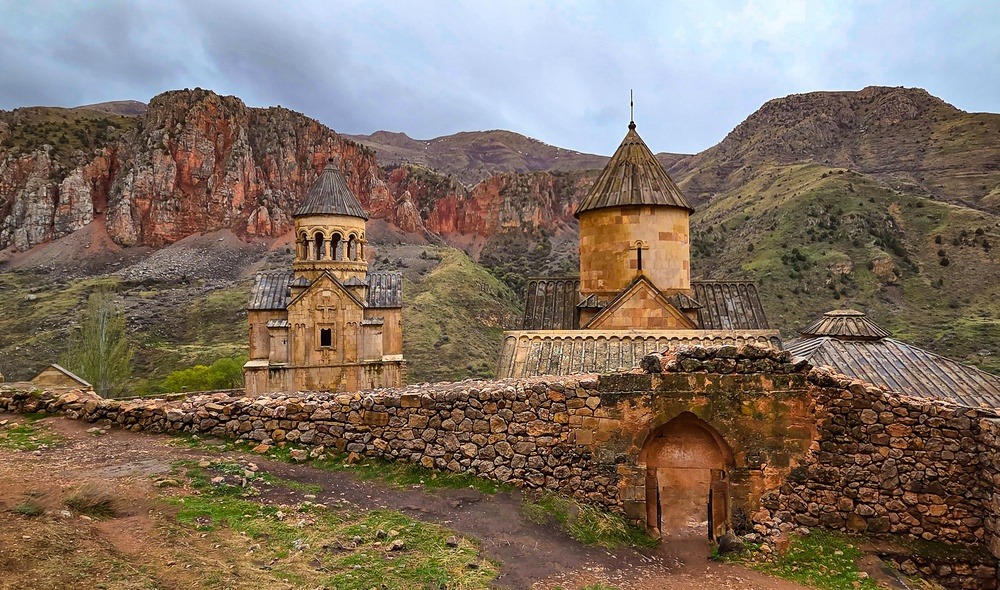
The most natural combination is with Vayots Dzor, crossed en route: Noravank, Areni and its caves, then descent to Goris in one day of driving with stops. For a full circuit, we then continue to Lake Sevan heading north, which avoids retracing the M2 in the other direction. Syunik suits contemplative travelers, medieval history and moderate hiking enthusiasts (the Transcaucasian Trail crosses the province) less so families with young children due to long driving stages. Accommodation comfort is acceptable without being luxurious: well-maintained family guesthouses in Goris and Halidzor, two or three mid-range hotels in Tatev.