Vayots Dzor
In southeastern Arménie, Vayots Dzor brings together medieval monasteries, ancient Areni vineyards and Jermuk thermal springs set against dramatic red canyon landscapes.
Add Vayots Dzor to your southeastern Arménie itinerary. Welcome to a destination of wonder and discovery. It is unquestionably the territory to explore for experiencing both the country's cultural heritage and natural riches.
History
Vayots Dzor means "valley of sorrows." It takes its name from an ancient canton of the historical Syunik province, ruled by the Siunia dynasty. The region has experienced continuous occupation for millennia, as evidenced by numerous archaeological remains.
It belonged to the great Armenian kingdoms and quickly played an important role in the country's political and cultural history. In the Middle Ages, its position along trade routes fostered the development of religious and intellectual centers. The following centuries witnessed conflicts and shifts in dominion. From the 19th century onward, Russian and later Soviet administration reshaped the region's organization, which today corresponds to the modern province of Vayots Dzor.
Discovering Vayots Dzor
Located at the southeastern tip of Arménie, Vayots Dzor covers 2,308 km² and is distinguished by its sparse population. It is home to only 53,230 residents according to the 2002 census. It is bordered to the west by Nakhchivan and to the east by Kashatagh. Yeghegnadzor, its capital, is also its largest city and the ideal starting point for exploring the region.
The region is primarily mountainous, organized around three main ranges:
- Vardenis Chain to the north, with Mount Vardenis peaking at 3,522 m.
- Arpa Chain in the center, home to the Vayots Sar volcanic cone (2,586 m).
- Vayk Chain to the south.
The lowest valley, that of Areni, sits at 850 m elevation.
It is also rich in watercourses and springs. The Arpa River, the province's main river, flows for 92 km through its territory, passing through Jermuk, Vayk, Yeghegnadzor and Areni before joining the Aras. Its numerous tributaries form spectacular waterfalls, notably at Jermuk and Herher. Among these, the Yeghegis River flows through a valley protected by the government as a wildlife reserve.
Discovering the Region's Ecosystems
Vegetation varies across valleys and slopes, with over 1,650 plant species and 150 tree types. The fauna is, in turn, spectacular. Mouflon and bezoar goats roam open spaces. Certain reptiles, such as the Armenian viper, complete the natural landscape.
Climate
The region experiences a continental climate, with hot summers reaching up to 41°C and cold winters dropping to −35°C. Annual precipitation ranges between 300 and 700 mm depending on the area.
Must-See Tourist Attractions
A variety of historic and cultural sites, along with natural and thermal destinations, await you in Vayots Dzor:
- Areni-1 Cave Complex: a major prehistoric site with the world's oldest known winery, dating back to the Chalcolithic period.
- Tanahat Monastery: founded in the 8th century, it exemplifies medieval Armenian religious architecture.
- Smbataberd Fortress: built in the 10th century, it testifies to the region's defensive history.
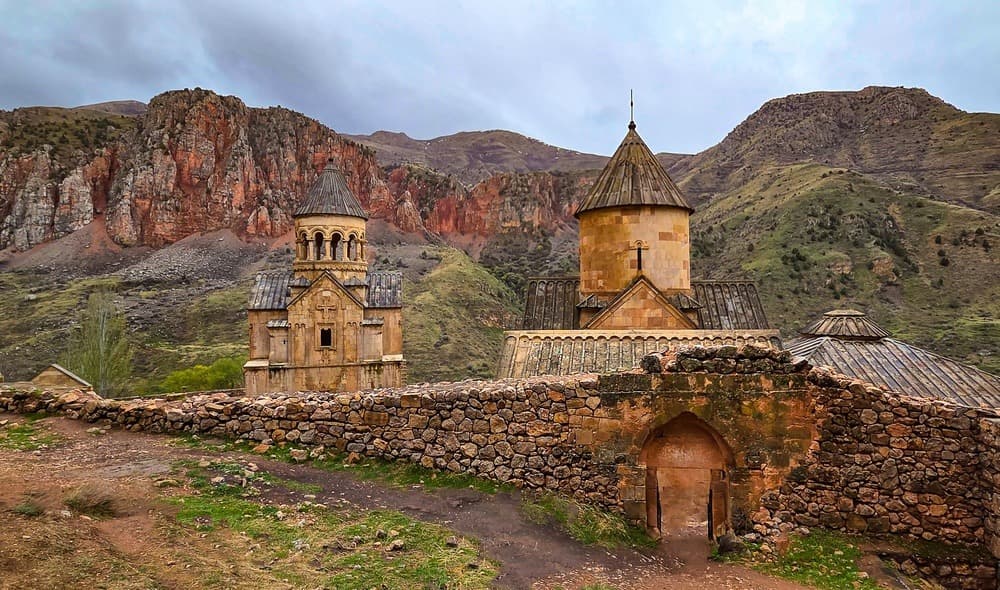
- Noravank Monastery: a 13th-century religious complex set amid dramatic mountainous landscapes.
- Jermuk Thermal Town: renowned for its mineral springs and mountain setting.
- Village of Gladzor: site of the medieval University of Gladzor, active during the 13th and 14th centuries.